Veterinary Procedure Codes: A Guide for Carriers and MGAs
On this page
- Why do veterinary invoices describe the same procedure differently?
- Is there a CPT equivalent for veterinary procedure codes?
- Which veterinary coding systems exist today?
- Why can't pet insurers just use CPT codes?
- What do inconsistent veterinary procedure codes cost carriers, MGAs and agencies?
- What do real coding inconsistencies look like?
- What does this look like inside an MGA's claims data?
- Can your claims data stand up to regulatory scrutiny?
- How should insurers standardize veterinary procedure codes without a universal standard?
- Can AI standardize veterinary invoice data accurately?
- What should you ask before buying a claims or bill-review platform?
- Where Insurnest fits
- The bottom line
- Sources
- About the author
- Frequently Asked Questions
Reviewed by Hitul Mistry · Verified October 9, 2026
No. The U.S. has no universally adopted system of veterinary procedure codes equivalent to CPT in human healthcare.
Clinical terminologies such as the Veterinary Extension of SNOMED CT and the U.K.'s VeNom codes exist, but none works as a shared billing language between clinics and pet insurers. Carriers and MGAs need their own normalization layer to compare procedures and costs reliably.
What are veterinary procedure codes? Veterinary procedure codes are identifiers for services performed on an animal, such as imaging, surgery or dental work.
In the U.S., each practice typically creates its own codes in its practice management software.
Key takeaways for carriers, MGAs and agencies
- Veterinary practices create their own billing codes inside their practice management software, so the same procedure can appear under different names on every invoice.
- Standards like VetSCT, VeNom, SA-PDT and the VMG/AAHA Chart of Accounts each solve a different problem. None is a U.S. insurance billing standard.
- Inconsistent veterinary procedure codes weaken loss-cost analysis, bordereaux reporting, fee benchmarking and your ability to defend claim decisions.
- The practical fix is an internal procedure taxonomy with preserved invoice text, bundle handling, confidence scoring, version control and human review.
Why do veterinary invoices describe the same procedure differently?
Veterinary invoices differ because each practice defines its own service codes in its own software, with no shared billing standard to align them.
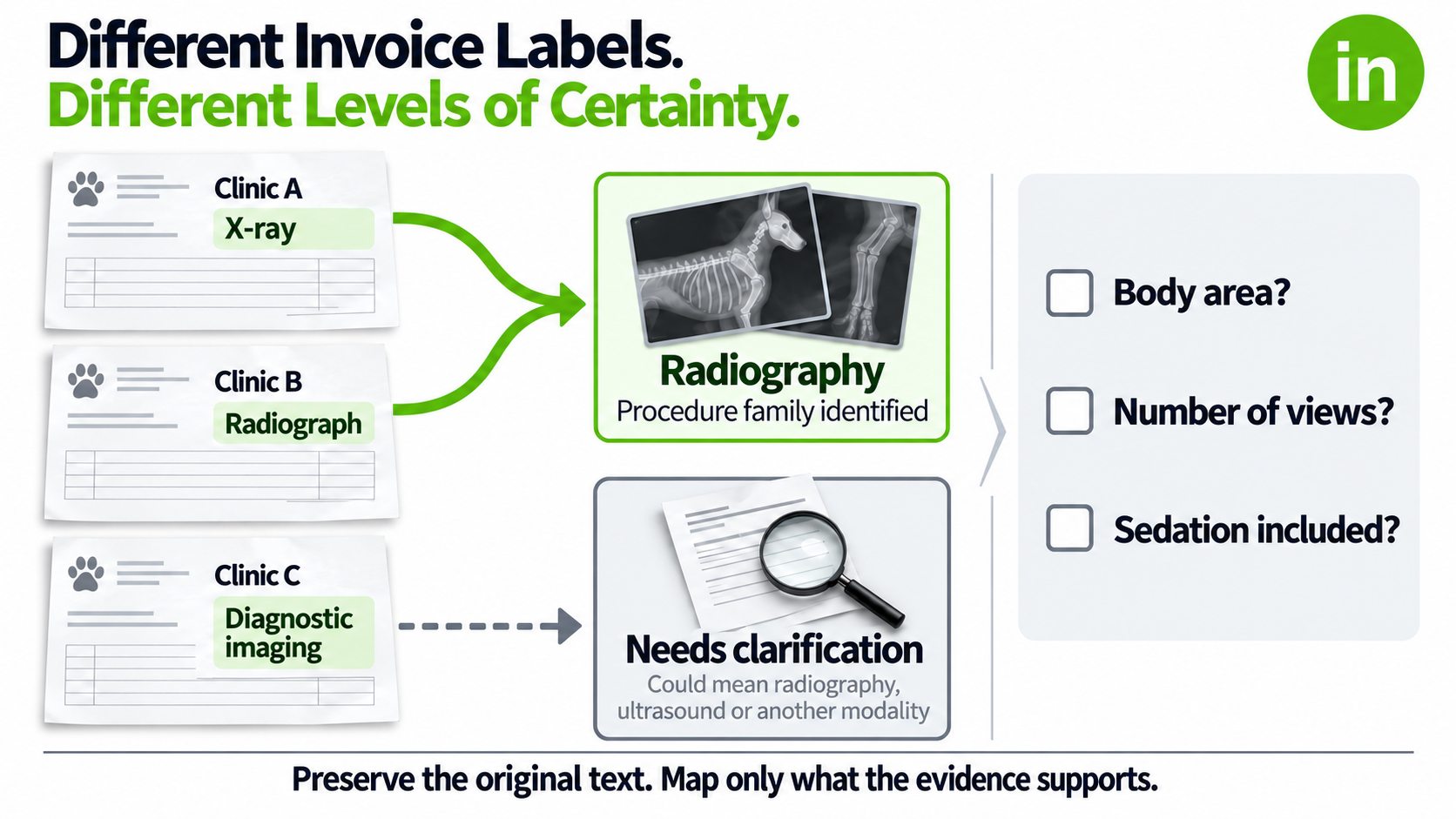
Picture three U.S. hospitals performing similar imaging work. Their invoices read:
| Hospital | Invoice line |
|---|---|
| A | X-ray |
| B | Radiograph |
| C | Diagnostic imaging |
"X-ray" and "radiograph" are close synonyms, but neither tells you the body area, number of views or whether sedation was included. "Diagnostic imaging" is broader still and could cover radiographs, ultrasound or both.
Now multiply that by every clinic in your book of business. Over time, veterinary practices have built their own systems for tracking services inside their practice management software.
Vetsource, whose VetSuccess team aligns practice revenue data, describes transaction coding across the industry as "a bit of a mess."
The takeaway for insurance leaders: veterinary coding standards do exist. What is missing is a single, widely adopted procedure billing language that U.S. pet insurers can rely on across clinics and software systems.
Is there a CPT equivalent for veterinary procedure codes?
No. We found no evidence of a universally adopted U.S. veterinary procedure coding system that plays the role CPT plays in human healthcare.
The research points the same way. In a research paper on automated veterinary diagnosis coding, Colorado State University (CSU) researchers report that most veterinary medical record systems do not include clinical coding infrastructure.
They also note that most automated coding work has focused on human health records, including for insurance claims, while veterinary medicine has seen limited work because it lacks a similar financial incentive.
That finding concerns clinical coding of medical records, not the billing codes practices create for their invoices. But the logic matters for pet insurers.
In human medicine, insurance billing is a major reason standardized codes exist. Veterinary medicine has never faced the same payer pressure, so standardization never had a forcing function.
Which veterinary coding systems exist today?
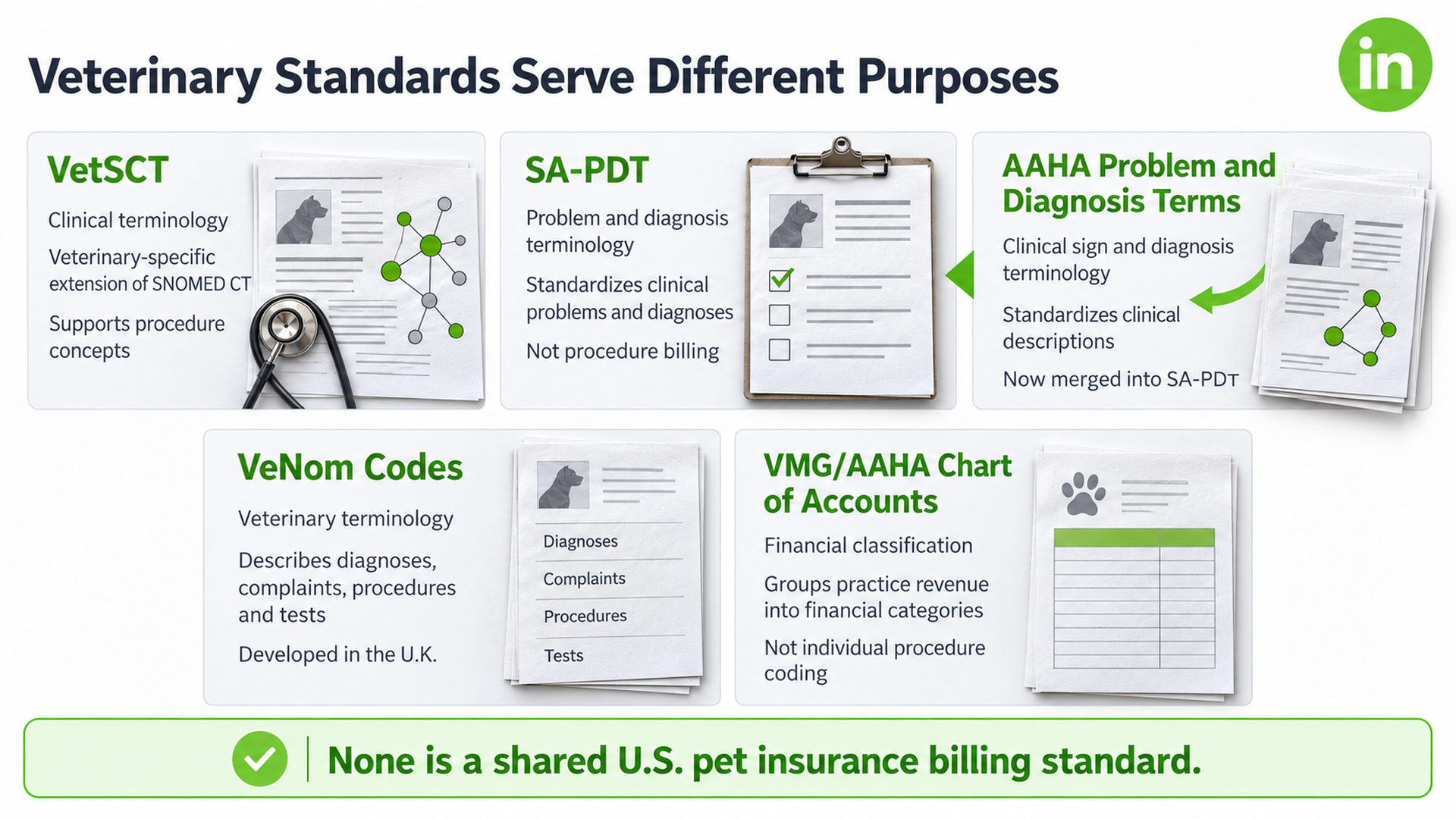
Several real standards exist, but when it comes to veterinary procedure codes for pet insurance, none was designed for the job. Each was built for a different purpose.
| System | What it covers | Includes procedures? | Access | Built for insurance billing? |
|---|---|---|---|---|
| Veterinary Extension of SNOMED CT (VetSCT) | Veterinary-specific content added to SNOMED CT, a clinical terminology. Maintained at Virginia Tech | Yes, through SNOMED CT procedure concepts | Subject to SNOMED CT licensing; U.S. organizations can obtain access through the National Library of Medicine | No |
| Small Animal Problem and Diagnosis Terms (SA-PDT) | Standardized problems and diagnoses for general, specialty and emergency practice | No | Distributed by Virginia Tech's Veterinary Terminology Services group | No |
| AAHA Problem and Diagnosis Terms | About 5,600 clinical sign and diagnosis terms mapped to SNOMED; now merged into SA-PDT | No | Via SA-PDT | No |
| VeNom Codes | Diagnoses, presenting complaints, procedures, diagnostic tests and reasons for visit. Developed in the U.K. | Yes | Free open access, subject to the VeNom Coding Group's terms | No |
| VMG/AAHA Chart of Accounts | Standard financial categories such as exams, vaccines, and hospitalization and treatment revenue | No (revenue categories, not procedures) | Through VMG and AAHA | No |
Three details matter for anyone budgeting a data program:
- Licensing: VetSCT use is subject to SNOMED CT licensing requirements. Factor this into vendor and legal review before you map to it.
- Funding: AAHA stopped funding its diagnosis terms, and Virginia Tech merged them into SA-PDT. Even established standards depend on someone paying to maintain them.
- Adoption: in the U.K., practices in the VetCompass research project are encouraged to use VeNom codes, but clinical coding remains entirely optional.
One signal worth watching: the VeNom Coding Group's February 2026 release included a French translation developed with input from pet insurer Trupanion. Insurers are starting to participate in terminology work, not just consume it.
What this means for a carrier or MGA: these standards are useful building blocks for an internal taxonomy, but you cannot expect clinics to send claims already coded in any of them.
Why can't pet insurers just use CPT codes?
CPT works because the entire U.S. human healthcare payment system is built around it, and it was never designed to describe veterinary care.
According to the Centers for Medicare & Medicaid Services:
- CPT is maintained by the American Medical Association and forms Level I of the federal HCPCS coding system.
- It identifies services furnished by physicians and other health care professionals that are billed to public or private health insurance programs.
- U.S. health insurers process over 5 billion claims a year, and CMS describes standardized coding as essential to processing them consistently.
CPT describes human procedures delivered by human health care professionals. It has no structure for species differences, veterinary-specific techniques or the way clinics bundle services.
Borrowing it would replace one mismatch with another.
What do inconsistent veterinary procedure codes cost carriers, MGAs and agencies?
When every clinic uses its own codes, three problems follow: comparisons break down, bundles hide costs and bad mapping creates false confidence.
Cost comparisons and benchmarks break down
Without code standardization, apples-to-apples comparisons between practices become very hard, and fee benchmarks become onerous, if not impossible, to build. If your pricing, reserving or network strategy depends on procedure-level cost trends, the trend is only as good as the mapping underneath it.
That matters more as veterinary cost inflation and corporate veterinary consolidation keep shifting what the same procedure costs from one clinic to the next.
Bundled charges hide the true cost
Consider three dental invoices (illustrative examples, not real invoices):
| Clinic | Invoice line |
|---|---|
| A | Dental cleaning |
| B | Dental prophylaxis |
| C | Dental package |
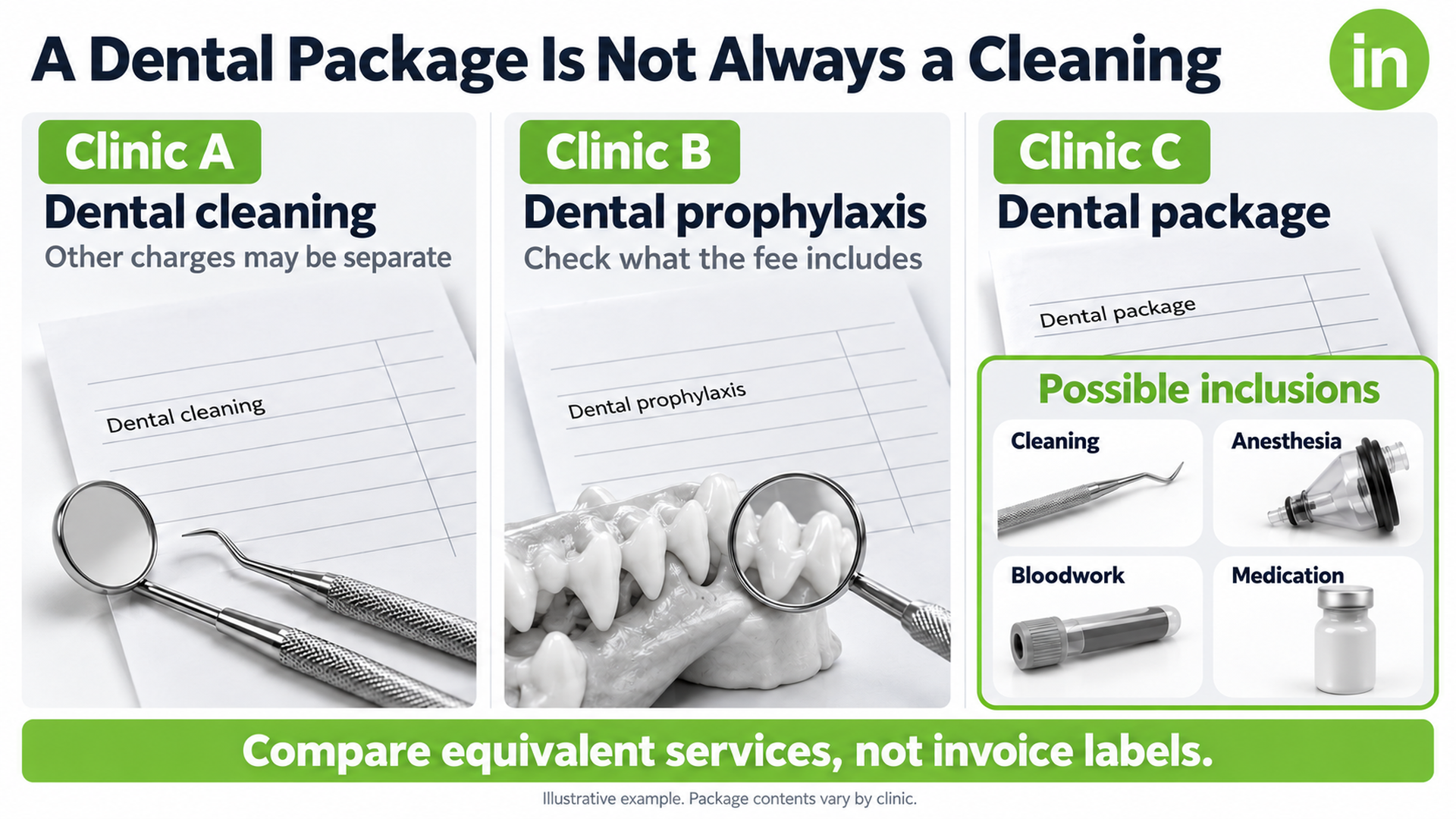
Clinic C's package might include anesthesia, bloodwork and medication. Clinic A's charge might cover only the cleaning.
Comparing them line for line makes Clinic C look expensive when it may simply be itemizing differently. A sound veterinary invoice verification process checks bundles before they reach cost comparisons or fraud rules.
Bad mapping is as misleading as no mapping
Labeling all three lines "dental" makes the data look clean while hiding real cost differences. Incorrect standardization can be as misleading as no standardization, and it is harder to detect because the reports look tidy.
How the impact differs by role
| Role | Where inconsistent veterinary procedure codes hurt |
|---|---|
| Carriers | Loss-cost trend and rate adequacy analysis, oversight of delegated MGA programs, and the ability to support claim decisions with consistent evidence |
| MGAs | Credibility of bordereaux and loss-run data shared with capacity partners, procedure-level pricing, and visibility into claims leakage |
| Agencies and producers | Explaining reimbursement outcomes to clients, handling disputes when similar treatments are paid differently, and protecting retention |
What do real coding inconsistencies look like?
Research on veterinary records shows the problem is not hypothetical:
- Synonyms: clinicians may record the same condition differently, such as "kidney disease" and "renal disease."
- Look-alikes: different conditions can have similar names, such as "gingival recession" and "gingivitis."
- Invoices as evidence: at the CSU teaching hospital, the medical records team checks the invoice to confirm which procedures were actually performed before coding a visit.
- Low adoption: Vetsource reports hearing from practice managers that switching to the standard Chart of Accounts was too much work for too little reward.
These examples come from diagnosis coding, not procedure billing. But they reveal two challenges that apply directly to claims: medical terms are hard to classify consistently, and accurate coding often requires cross-checking clinical and billing records.
Invoice descriptions alone may not establish what treatment was actually performed.
What does this look like inside an MGA's claims data?
Illustrative scenario: the figures below are a modeled example built from the patterns described in this article. They are not results from a specific Insurnest client.
Consider a mid-sized pet insurance MGA reviewing six months of closed claims: about 18,000 veterinary invoices from roughly 2,400 clinics. Its reporting had grouped invoice lines by keyword, so every line containing "dental" landed in one category and every imaging line in another.
When the data team looks more closely, three patterns appear:
- Description sprawl: thoracic radiographs show up under 31 different invoice descriptions, from "Rads 2V thorax" to "Chest films" to "Imaging – thoracic."
- Hidden bundles: about one in four dental claims is billed as a single package, with no itemized anesthesia, bloodwork or medication.
- Uncertain lines: about 9% of invoice lines can't be mapped with confidence because of abbreviations, vague descriptions or missing quantities.
Here's how the picture changes after the MGA applies the six-step framework described below:
| Measure | Keyword grouping | After normalization |
|---|---|---|
| Thoracic radiograph descriptions | 31 separate labels | 1 internal code, original text kept |
| Dental package claims | Compared directly with itemized cleanings | Flagged and compared only like for like |
| Clinics flagged as dental cost outliers | 46 | 11 |
| Invoice lines sent to human review | None (everything auto-categorized) | About 9%, low-confidence lines only |
Most of the "expensive" clinics weren't expensive at all. They were billing packages that included services their peers itemized separately.
The 11 clinics that remained outliers became a short, defensible list for claims and network review, and the MGA's bordereaux now report procedure-level costs its capacity partners can compare period to period.
Can your claims data stand up to regulatory scrutiny?
Consistent procedure data is becoming a compliance asset, not just an analytics nice-to-have.
The NAIC Pet Insurance Model Act (#633), adopted in 2022, had been adopted by 16 jurisdictions as of March 2026. Among other provisions, the model places the burden on the insurer to prove that a preexisting-condition exclusion applies, and it sets training requirements for producers.
If a claim decision depends on what treatment a pet received and when, your team needs to show how each invoice line was interpreted. That is hard to do when the same procedure appears under five names across a pet's history.
Confirm with counsel how the model, or your states' versions of it, applies to your programs.
How should insurers standardize veterinary procedure codes without a universal standard?
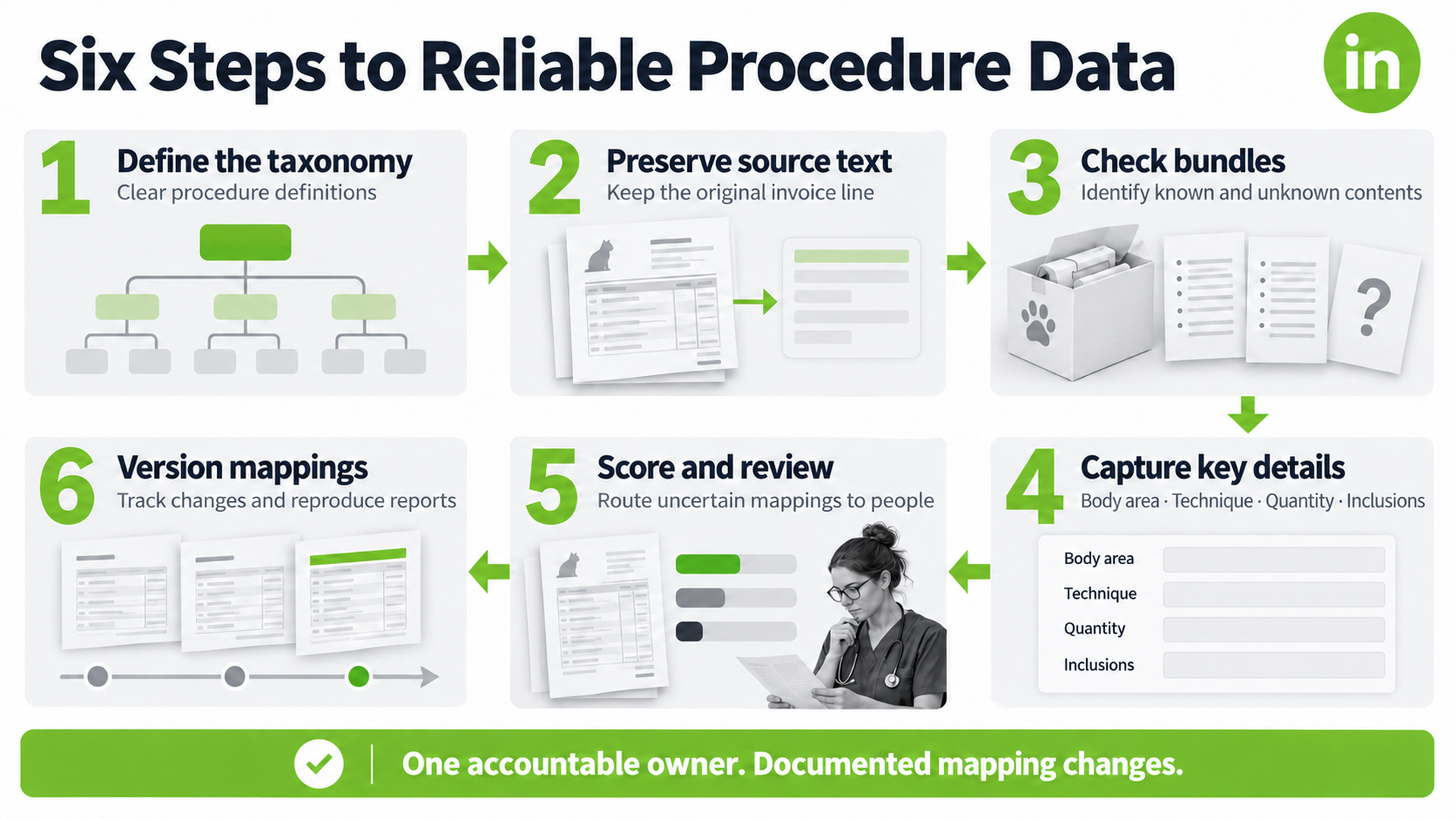
You do not need to wait for an industry standard. Build a controlled normalization layer with six components.
(For the clinic-facing side, such as invoice fields and practice management integrations, see our guide to veterinary invoice standardization for pet insurance claims.)
- Create an internal procedure taxonomy with clear definitions, and map it to existing standards such as SNOMED CT procedure concepts where your license allows. At the CSU teaching hospital, procedures could be coded with straightforward rules because the hospital's own procedure terms were already standardized. Consistency at the source makes everything downstream easier.
- Keep the original invoice text next to every mapped code, so reviewers, auditors and capacity partners can always see what the clinic actually wrote.
- Identify bundled charges and separate their components only when the invoice or supporting records give enough detail. When package contents are unknown, flag them rather than guessing or comparing them with itemized procedures.
- Capture the details that drive claims outcomes: body part, technique, quantity and what the fee included.
- Score confidence on every mapping, test those scores against human-reviewed records, and route low-confidence items to reviewers.
- Version your mappings so taxonomy changes don't distort cost trends, rate filings or year-over-year bordereaux comparisons.
Worked example: one invoice line, start to finish
Here's how a single line moves through the six steps (illustrative):
| Step | Output |
|---|---|
| Original invoice text (kept) | Rads 2V thorax |
| Interpreted procedure | Thoracic radiographs, two views |
| Internal procedure code | IMG-RAD-THX-02 |
| Standard reference | Mapped to a SNOMED CT chest radiography procedure concept, where licensed |
| Body part / technique / quantity | Thorax / radiography / 2 views |
| Bundle check | Sedation not listed; check medical record before comparing costs |
| Confidence | High: common abbreviation with a validated mapping |
| Mapping version | v2026.3 |
A line like "Dental package" would take the same path but stop at the bundle check, where it would be flagged for review rather than compared with itemized cleanings.
Governance tip: assign one owner for the taxonomy, usually a joint claims and data role, and document every change. A mapping table without an owner degrades quietly.
Can AI standardize veterinary invoice data accurately?
AI can help with pet insurance claims coding, but published results measure related tasks, not U.S. veterinary procedure billing accuracy. Treat vendor numbers accordingly.
| Use case | Reported result | What it actually measures |
|---|---|---|
| Revenue classification | Vetsource's VetSuccess reported over 95% first-pass accuracy mapping practice revenue codes to Chart of Accounts categories, with people experienced in veterinary practice auditing the mapped sets | Financial categorization from the company's own audits, not claims |
| Clinical record review | In a Google Cloud case study, Australian pet insurer Fetch described medical history reviews that took a specialist up to three hours, reported cutting them to minutes with over 95% accuracy in coding conditions, and kept vet-trained agents validating results | Vendor-reported condition coding, not procedure billing |
| Diagnosis coding | In the CSU study, the best model matched human coders exactly on 52.2% of visits across 7,739 SNOMED CT diagnosis codes. The researchers recommend AI that suggests codes humans can accept, reject or add to | Exact-match diagnosis coding on a teaching-hospital dataset |
None of these results directly measures the accuracy of automated veterinary procedure coding for U.S. insurance claims.
A practical operating model combines approved mapping rules, veterinary terminology and AI-assisted classification:
- Clear, common descriptions follow validated mappings automatically.
- Ambiguous procedures, unfamiliar abbreviations and incomplete bundles go to human review before they affect a claim decision. This is where pet insurance claims triage earns its keep, routing uncertain lines to the right reviewer.
The goal is not to classify every invoice line automatically. It is to produce reliable, explainable procedure data without hiding uncertainty.
If you are evaluating the extraction layer that feeds this process, our comparison of veterinary invoice OCR and AI tools covers accuracy, cost and fit by claims volume.
What should you ask before buying a claims or bill-review platform?
Use these questions in your next vendor evaluation or RFP:
- Does the platform keep the clinic's original invoice text alongside every standardized code?
- How does it handle bundled packages when contents are not itemized?
- Is every mapping assigned a confidence score, and what threshold triggers human review?
- Has accuracy been measured on U.S. veterinary invoices for procedures, not just diagnoses or revenue categories?
- Are mapping tables versioned, and can you reproduce last year's numbers after a taxonomy change?
- If the platform maps to SNOMED CT or VetSCT, who holds the license?
- Can you export normalized procedure data in a format your carrier partners, reinsurers or auditors can use?
If a vendor cannot answer the fourth and fifth questions clearly, treat its accuracy claims with caution.
Where Insurnest fits
Insurnest builds AI agents for pet insurance carriers, MGAs and agencies, covering veterinary bill review, fee benchmarking by geography, facility type and procedure, treatment cost estimation, and claims triage.
On the claims side, the Pet Claims Triage AI Agent scores and routes each claim, with veterinary bill review and fee validation built into its auto-adjudication checks. On the pricing side, the Pet Insurance Pricing AI Agent and the Geographic Vet Cost Adjustment AI Agent use local veterinary cost data so rates reflect what procedures actually cost where your policyholders live.
Human experts still decide how each case is handled.
The goal is not to replace clinical judgment. It is to give carriers, MGAs and agencies a consistent way to read inconsistent invoices.
Talk to our pet insurance specialists to see how this works on your own claims data.
The bottom line
In short: U.S. pet insurers can't rely on a shared veterinary procedure coding standard. VetSCT, VeNom, SA-PDT and the VMG/AAHA Chart of Accounts each serve a different purpose.
Carriers and MGAs get reliable procedure data by building an internal taxonomy that keeps original invoice text, flags bundles, scores confidence and versions every mapping.
Veterinary procedure codes exist in pieces: clinical terminologies, diagnosis lists, a U.K. coding system and a financial chart of accounts. None of them gives U.S. pet insurers a ready-made billing language.
Until one exists, every carrier, MGA and agency should ask one question: when two invoices describe the same procedure differently, can your claims system tell, and can it prove it?
Sources
- Colorado State University: Fine-tuning foundational models to code diagnoses from veterinary health records
- Virginia Tech Veterinary Terminology Services: VetSCT, VetSCT FAQ, Small Animal PDT
- AAHA: Problem and Diagnosis Terms
- VeNom Coding Group: VeNom Codes
- Royal Veterinary College: VetCompass support
- AAHA: Updated VMG/AAHA Chart of Accounts
- Vetsource: AAHA/VMG Chart of Accounts adoption
- CMS: Healthcare Common Procedure Coding System (HCPCS)
- Google Cloud: Fetch customer story
- NAIC: State Implementation Report of NAIC-Adopted Model Laws
About the author
Hitul Mistry writes for Insurnest, an insurance technology company founded in 2020 that builds AI agents and digital platforms for insurers, reinsurers, MGAs and brokers. Insurnest's pet insurance work spans claims triage, pricing and geographic veterinary cost analysis for carriers and MGA programs.
How this article was created: Insurnest's editorial team researched primary sources, including published research, standards bodies, regulators and federal agencies. The article was drafted with AI assistance, and every statistic and claim was then fact-checked against the original sources linked above before publication.
This article is for informational purposes and is not legal or regulatory advice.
Frequently Asked Questions
What are veterinary procedure codes?
Veterinary procedure codes are identifiers that describe services performed on an animal, such as imaging, surgery or dental work. In the U.S., most are created by individual practices inside their practice management software, so codes and descriptions vary from clinic to clinic.
Are there veterinary procedure codes for pet insurance claims?
Not as a shared standard. Pet insurers receive invoices coded with each clinic's internal codes, so carriers and MGAs typically normalize them into their own procedure taxonomy, mapped to references such as SNOMED CT or VeNom where licensing allows.
Do veterinarians use CPT codes?
No. CPT is maintained by the American Medical Association for services furnished by human health care professionals and billed to health insurance programs. U.S. veterinary practices generally use their own internal codes instead.
Is SNOMED CT used in veterinary medicine?
Yes. The Veterinary Extension of SNOMED CT (VetSCT), maintained at Virginia Tech, adds veterinary-specific content to SNOMED CT. Its use is subject to SNOMED CT licensing, and it is a clinical terminology rather than an insurance billing standard.
What are VeNom codes?
VeNom codes are a standardized veterinary terminology developed in the U.K. by the VeNom Coding Group. They cover diagnoses, presenting complaints, procedures and diagnostic tests, and are free to access under the group's terms. Their use is optional.
Why do inconsistent veterinary procedure codes matter for pet insurance MGAs?
MGAs share bordereaux and loss data with carriers and capacity partners. When the same procedure appears under different names, procedure-level cost trends, pricing analysis and claims leakage reviews become unreliable, which can weaken those partner relationships.
Can AI map veterinary invoices to standard procedure codes?
AI can help, especially when paired with approved mapping rules, confidence scoring and human review. However, published accuracy figures measure related tasks, such as revenue classification or diagnosis coding, not U.S. veterinary procedure billing.
What is the first step to standardizing veterinary invoice data?
Start with an internal procedure taxonomy with clear definitions, keep the original invoice text next to each mapped code, and assign one owner to govern and version the mappings.

Hitul Mistry
CEO, Insurnest
An InsurTech leader with more than a decade of experience across insurance and technology, focused on solving business problems with the help of technology. Has worked with brokers, insurance carriers, and reinsurance firms across the India, UAE, and US markets.
View LinkedIn profile →
