Corporate Veterinary Consolidation: Impact on Pet Insurers
On this page
- What is corporate veterinary consolidation?
- Does corporate veterinary consolidation raise claim costs?
- How does consolidation show up in a pet insurance P&L?
- What does this mean for carriers, MGAs and agencies?
- Is consolidation always negative for insurers?
- What should pet insurance leaders do in the next 90 days?
- How Insurnest helps
- Where this leaves pet insurers
- Sources
- Frequently Asked Questions
Reviewed by Hitul Mistry
Executive brief: Corporate veterinary consolidation can push treatment prices up, and the best evidence we have says it can push insurance claim values up too.
When the U.K.'s competition regulator studied acquisitions, it found that at least three large groups had raised prices about 9% above trend within four years. Insurance claim values at those clinics were about 5% higher.
Nobody has measured this across the U.S. yet, and that's the real risk for U.S. pet insurers. A cost driver tied to ownership can sit quietly inside your overall vet inflation number, where your pricing, reserving and partner reviews won't catch it.
What leaders need to know
- Corporate groups own an estimated three out of four U.S. specialty and emergency practices. Those are the hospitals behind your biggest claims.
- Deductibles don't move when bills do. So a vet bill that's 20% higher can mean the insurer pays 23–27% more.
- In the year to August 2026, U.S. veterinarian services prices rose 5.7%. Overall consumer prices rose 3.4%.
- The best U.S. vet price data you can get is probably already in your itemized claims. It just isn't tied to hospital ownership yet.
What is corporate veterinary consolidation?
Corporate veterinary consolidation is when large corporate groups and private-equity-backed companies buy up independent vet clinics.
Most clinics keep their old name and staff after the sale. That means your claims system could list hundreds of hospital names that really belong to a handful of companies, and no standard report will show you which ones.
In the U.S., Mars owns Banfield, BluePearl and VCA. JAB is the controlling shareholder of National Veterinary Associates (NVA).
A 2025 peer-reviewed analysis in Frontiers in Veterinary Science estimates how far this has gone:
| Practice type | Estimated corporate ownership | Relevance to your book |
|---|---|---|
| Specialty and emergency | ~75% | Drives your largest, most volatile claims |
| Primary care | ~25% | Drives claim frequency and routine severity |
| Share of U.S. veterinary revenue | ~50% | Roughly half of every claim dollar may flow to consolidated owners |
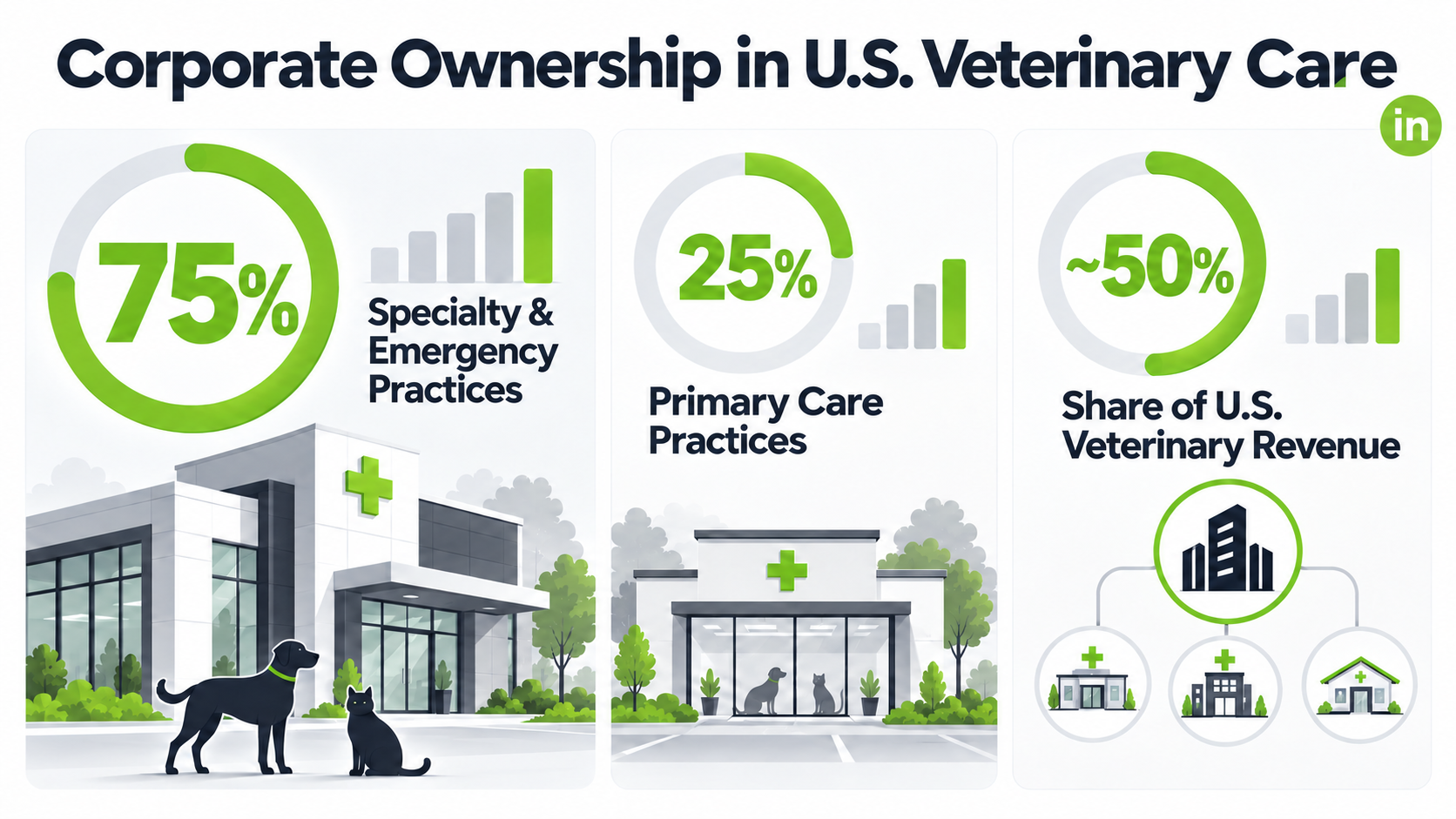
These are estimates, not an up-to-date count of who owns what.
Does corporate veterinary consolidation raise claim costs?
It can. The strongest price evidence comes from the U.K. In the U.S., regulators and researchers have looked at competition, not prices.
What U.S. regulators and researchers have found
- Mars and VCA (2017): The FTC made Mars sell 12 specialty and emergency clinics in 10 localities. It warned that, without a fix, the deal would likely mean higher prices and lower quality.
- JAB and Ethos (2022): The FTC ordered divestitures in Richmond, Denver, San Francisco and the Washington, D.C. area. It also required JAB to get prior approval for, and give notice of, future specialty and emergency acquisitions.
- Local market effects: A 2025 study in the Journal of the Agricultural and Applied Economics Association found that once a corporate practice entered a local market, independent practices became 1.9% more likely to close. Their employment fell 5.7% and their revenue fell 6.9%.
Notice what's missing, though. None of these looked at what happened to treatment prices once the deals closed.
What the U.K. regulator measured
In March 2026, the U.K. Competition and Markets Authority (CMA) published its final decision on veterinary services. Here's what it found:
| CMA finding | Result | What it means for insurers |
|---|---|---|
| Prices at five large groups vs. independents | 18.3% higher on average (Jan 2023–Jul 2024) | Not quality-adjusted; varied widely by group |
| Prices after acquisition, vs. prior trend | ~9% higher after four years | Seen in at least three of five acquiring groups |
| Insurance claim values after acquisition | ~5% higher after four years | The most direct evidence on claim costs available anywhere |
| Groups with no measurable acquisition effect | One | Ownership alone doesn't decide the outcome |
| Profitability of large groups | Several earned profits well above their cost of capital over a sustained period | Higher prices weren't simply offset by investment in quality |
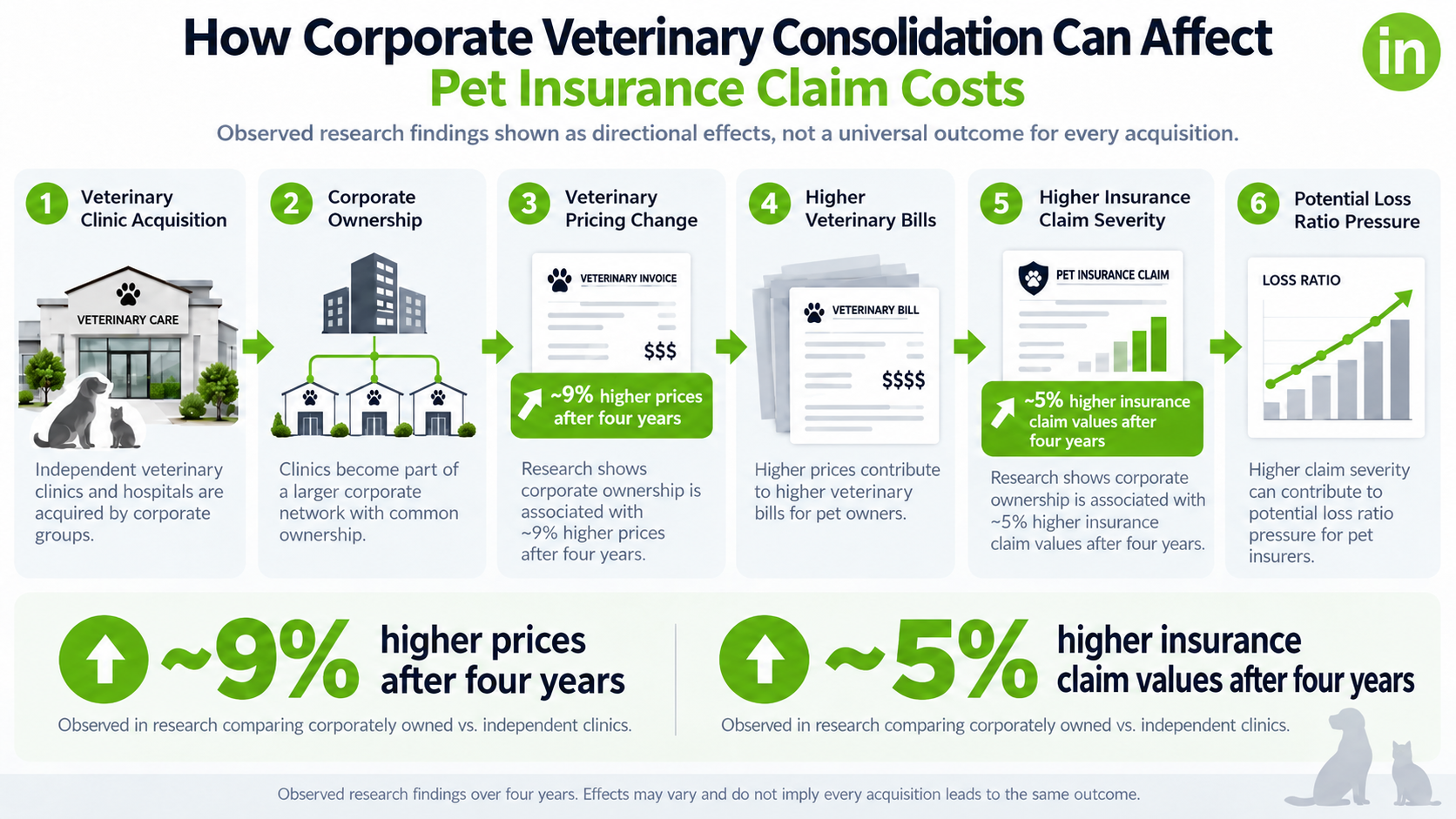
Why the U.K. numbers shouldn't go straight into a U.S. pricing model
It's tempting to take the CMA's 5% and drop it straight into a U.S. trend assumption. We wouldn't, and here's why.
The groups didn't all behave the same way. One of the five showed no acquisition effect at all, so a lot depends on who the buyer is.
Average it out nationally and you lose exactly the difference you need to see.
The markets are also built differently.
The U.K. investigation focused largely on first-opinion practices, while U.S. consolidation is heaviest in specialty and emergency care. So the effect on a referral-heavy claim book could be bigger or smaller.
And pet insurance is far more common in the U.K. than in the U.S. That could change how clinic prices respond to new ownership, which makes copying the claims finding across unreliable.
Our view? Use the U.K. result as a strong reason to measure your own data, not as a number to price with.
How does consolidation show up in a pet insurance P&L?
Claim severity can climb for three separate reasons, and each one needs a different response:
| Driver | What changes | Where it shows up | Likely response |
|---|---|---|---|
| Price | The same service costs more | Unit costs for standardized line items | Pricing trend, provider conversations |
| Intensity | More tests and procedures per case | Line items per diagnosis | Clinical review, benefit design |
| Setting | More care moves to specialty and ER hospitals | Mix of claim dollars by facility type | Network strategy, telemedicine triage |
A worked example: splitting a 12% severity increase
Let's say your average orthopedic claim went up 12% last year. Before you draw any conclusions, break it apart.
The three drivers multiply rather than add:
| Driver | Illustrative change |
|---|---|
| Price: the same procedures cost more | +6.0% |
| Intensity: more line items per case | +3.0% |
| Setting: more cases treated at specialty hospitals | +2.7% |
| Combined (1.060 × 1.030 × 1.027) | ≈ +12.1% |
Figures are illustrative.
Each piece leads to a different conversation.
The price piece goes into your trend assumption and, if it clusters around one owner, into talks with providers. The intensity piece is a clinical question for your vet reviewers.
The setting piece might be perfectly appropriate care. Or it might mean routine cases are ending up in emergency hospitals because policyholders had no cheaper option at the right moment.
There's a visibility problem too. The CMA found that at four of the six large U.K. groups, the branding didn't make it clear to clients that their clinic was part of a group.
Your claims system probably has the same blind spot.
Why deductibles magnify price increases
Take a simple example: a policy that reimburses 80%.
| Hospital A | Hospital B | Change | |
|---|---|---|---|
| Veterinary bill | $2,000 | $2,400 | +20% |
| Insurer pays ($250 deductible) | $1,400 | $1,720 | +22.9% |
| Insurer pays ($500 deductible) | $1,200 | $1,520 | +26.7% |
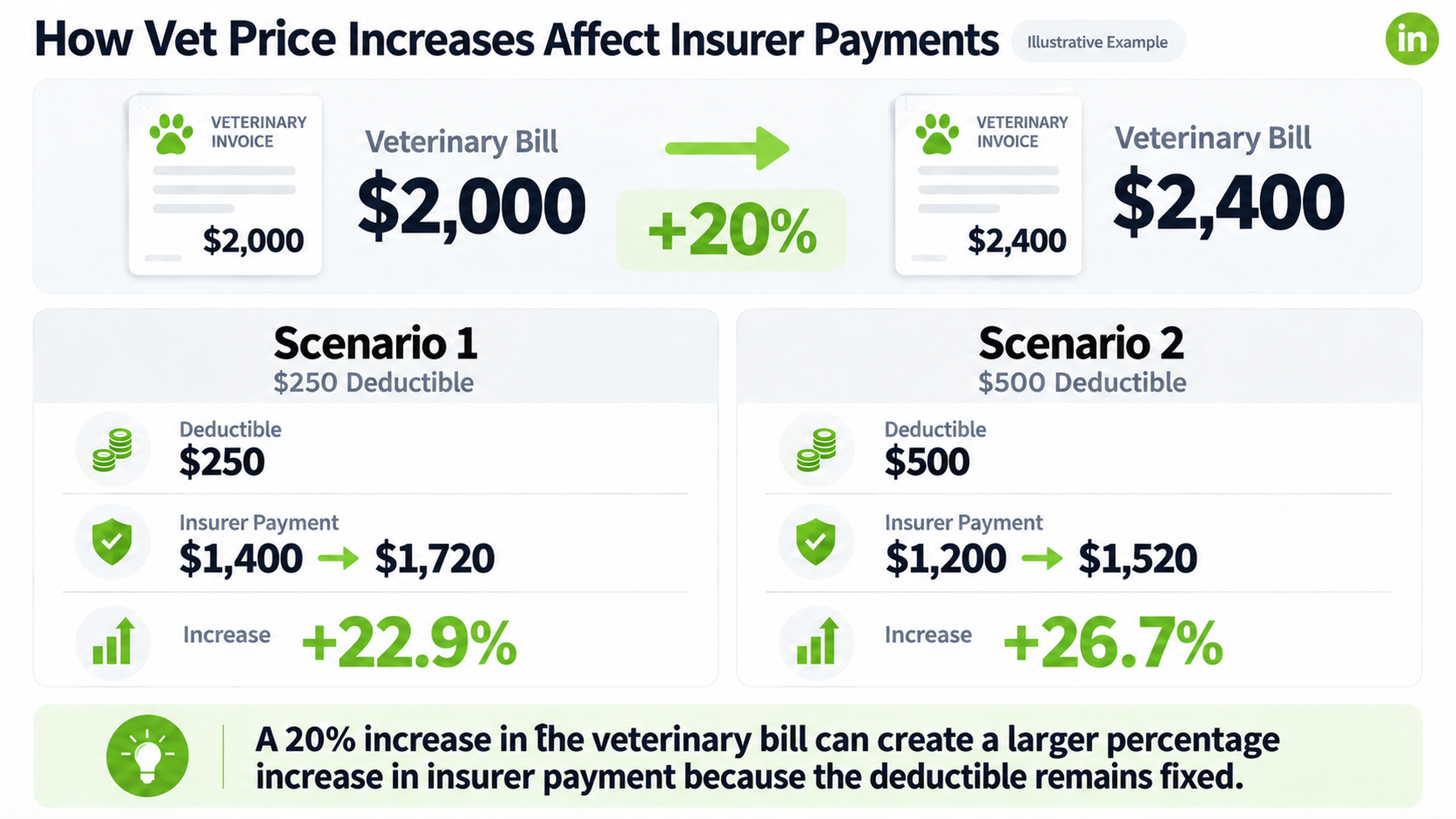
Figures are illustrative.
Here's why it happens. The deductible stays the same when the bill goes up, so every extra dollar above it gets reimbursed at 80%.
The higher the deductible, the bigger the jump in what the insurer pays. If a lot of your book is on high-deductible plans, provider price increases will hit you harder than the headline inflation number suggests.
What the loss ratio impact looks like
Picture an illustrative $20 million pet book running at a 70% loss ratio. If claims rise 10% and premium stays flat, the loss ratio climbs to 77%.
That's about $1.4 million in extra claims. If you're an MGA with a profit commission tied to loss ratio, a shift that size can take a real bite out of it.
For typical targets, take a look at our pet insurance MGA loss ratio benchmarks. If your ratio is already slipping, our loss ratio deterioration remediation playbook can help.
What does this mean for carriers, MGAs and agencies?
Each group feels corporate veterinary consolidation differently. Carriers feel it in rate adequacy and reserving, MGAs in capacity relationships and pricing speed, and agencies in renewals and growth.
For carriers
Pet insurance rate changes usually have to be filed with state regulators, and every filing needs a trend assumption you can defend. If a consolidation effect is mixed into general vet inflation, that gets harder.
Our guide to pet insurance actuarial pricing and rate filing walks through how trend assumptions are built and supported.
Reserving is the other worry. Price increases tied to ownership tend to stick around, unlike a one-off inflation spike, so if you spot them late, you can end up under-reserved.
And if you write through MGAs, ask them whether their pricing trend accounts for who owns the hospitals in their markets.
For MGAs
- Capacity relationships: If you can explain how much of your trend comes from price, intensity and setting, you're in a stronger position when you sit down with your fronting carrier partner.
- Geographic concentration: Consolidation happens market by market. If your book is concentrated in a few metros, your trend could look very different from the national average.
- Pricing speed: In the first half of 2026, Trupanion's subscription cost of paying vet invoices rose about 13%, while its monthly revenue per pet rose about 10% (from $78.73 to $86.62), so its pricing kept up. Re-pricing that fast takes trend evidence that will hold up with regulators and carrier partners.
For agencies and distribution partners
Agencies don't carry the claims risk, but they feel it at renewal time.
NAPHIA data shows U.S. pet insurance premiums grew 19.7% in 2025, while the number of insured pets grew 9%. Clients facing bigger increases will ask why, and some will leave.
That's why it's fair to ask about cost drivers during partner due diligence. Carriers and MGAs that understand what's driving their claims are in a better position to keep rates steady.
It matters for growth too. Only 4.27% of U.S. pets are insured, which leaves a big pet insurance demand gap, and unexplained claim inflation makes coverage harder to sell.
A structural issue every leader should watch
JAB describes itself as the controlling shareholder of both NVA and Independence Pet Holdings, a major pet insurance group that now operates under the Doubtless name together with Pinnacle Pet Group. Back in 2021, then-senior partner David Bell said consumer spending data from JAB's clinics would help it price premiums.
That doesn't tell us how, or whether, that data is used today. But it does show that ownership links between clinics and insurers can create an information advantage.
It's one more reason to know who owns the hospitals behind your claims.
Is consolidation always negative for insurers?
No. The FTC has pointed out that specialty and emergency clinics are hard to open because specialist vets are hard to recruit. Established networks can make it easier for your policyholders to get the care they need.
Still, the U.K. findings are a warning. Pet owners' net satisfaction with cost was 26% at large groups, compared with 47% at independents.
And the CMA found that better service quality didn't fully explain the higher prices.
Higher-cost care isn't the same as lower-value care. An expensive referral can be exactly the right medicine.
The goal is to understand cost, not to penalize appropriate specialty treatment.
What should pet insurance leaders do in the next 90 days?
Start by linking every hospital in your claims data to its parent company. Then separate price, intensity and setting before you change any pricing assumptions.
Public price data won't help here. A 2026 study of 177 small animal clinics across eight states found that only 3 of the 157 clinics with websites posted any prices at all.
Your own claims are a much better source.
| Timeframe | Action | Owner |
|---|---|---|
| Days 1–30 | Map your top hospitals by claim dollars to their parent companies, and record acquisition dates | Claims operations / data |
| Days 1–30 | Measure concentration: what share of claim dollars in each market goes to one ownership group? | Actuarial |
| Days 31–60 | Standardize invoice line items so like-for-like procedures can be compared (see our guide to veterinary invoice standardization) | Claims / technology |
| Days 31–60 | Split severity trend into price, intensity and setting | Actuarial |
| Days 61–90 | Compare acquired hospitals before and after the deal against similar hospitals that weren't acquired | Actuarial / analytics |
| Days 61–90 | Feed confirmed findings into pricing assumptions, rate filings and partner reviews | Leadership |
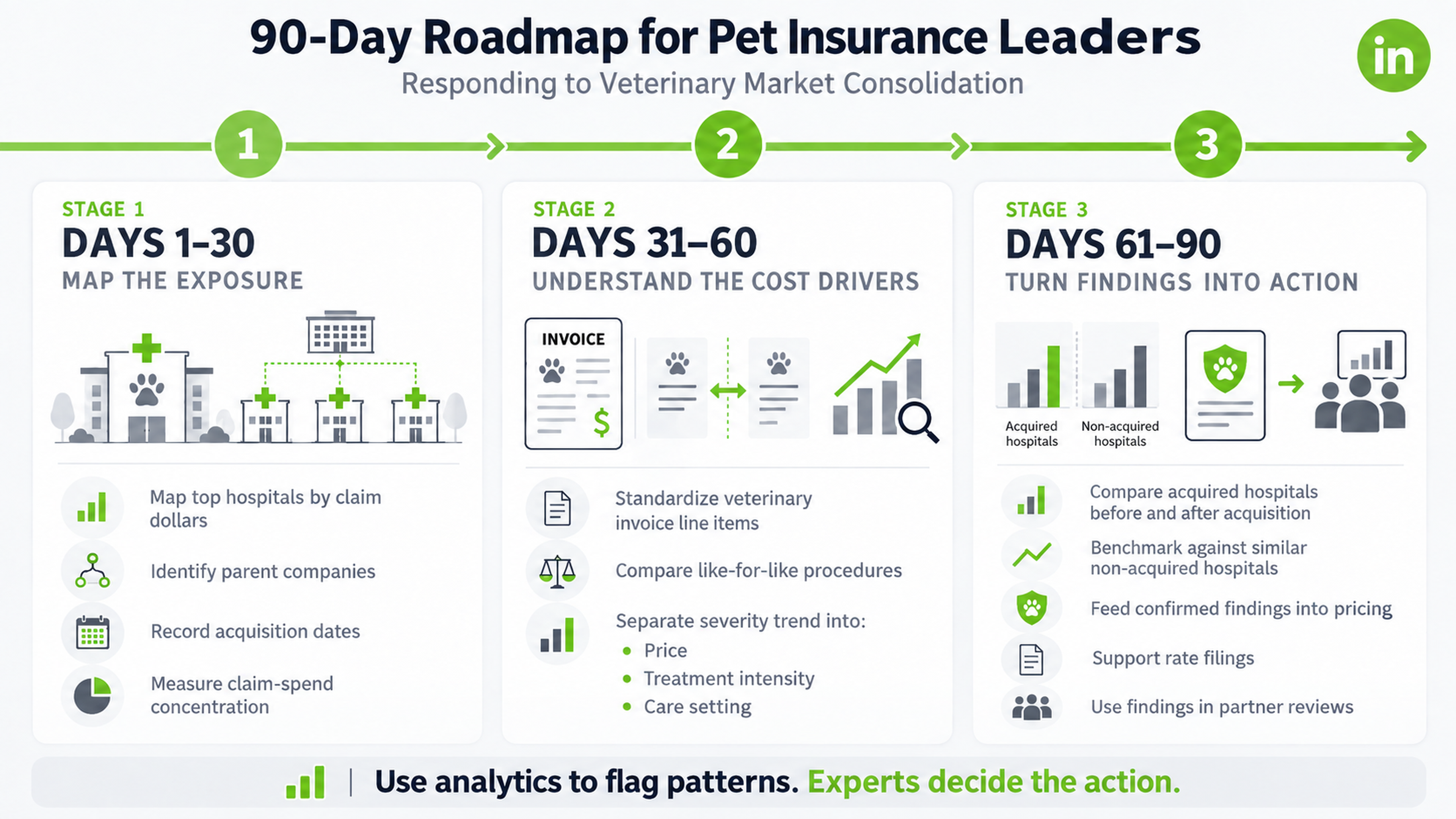
One word of caution. A high bill is a reason to look closer, not a reason to pay less.
Never deny or reduce a valid claim just because it's above a benchmark. Confirmed differences belong in your pricing, your forecasts and your conversations with providers.
Five questions to put to your leadership team
- What percentage of our claim dollars goes to corporate-owned hospitals, by market?
- How much of last year's severity increase came from price, intensity and setting?
- Which of our markets have seen major acquisitions in the past three years?
- Do our current rate filings or capacity agreements reflect these trends?
- Could we defend our trend assumptions to a regulator, carrier partner or reinsurer today?
How Insurnest helps
Disclosure: Insurnest builds the tools described below.
Our pet insurance agents handle veterinary bill review, fee benchmarking by geography, facility type and procedure, treatment cost estimation and claims triage. Paired with verified ownership records, they help:
- Carriers build trend assumptions that are better supported.
- MGAs explain loss ratio movement to their capacity partners.
- Claims teams look into pricing differences with structured evidence.
Human experts still make the call on what to do next. Learn more about our pet insurance pricing AI agent and invoice-based claims verification.
Where this leaves pet insurers
Who owns the hospitals behind your claims has changed a lot over the past decade, and it's still changing.
The U.K. has shown that acquisitions can push up prices and claim values. In the U.S., regulators have stepped into specific local markets, but no one has measured the price effect nationally.
Insurers that can explain where their severity trend is coming from will price more accurately, file with more confidence and negotiate capacity from a stronger position. And the data you need to do that is already sitting in your claims.
Sources
- CMA, Veterinary services for household pets: final decision report summary (March 2026)
- FTC, final order in Mars/VCA (2017)
- FTC, final order against JAB Consumer Partners in Ethos acquisition (2022)
- Steinbach (2025), The corporatization of veterinary medicine and its impact on independent practices
- Traub-Werner et al. (2025), Making the case for a resurgent U.S. independent veterinary practice segment
- Adams et al. (2026), Lack of online price transparency of small animal veterinary clinics in the United States
- U.S. Bureau of Labor Statistics, CPI release, August 2026
- Trupanion, Q2 2026 results (SEC Form 8-K)
- NAPHIA, 2026 State of the Industry Report highlights
- JAB, corporate press release (controlling shareholdings)
How this article was produced: It is based on public regulator reports, peer-reviewed research, company filings and industry data. The dollar, severity and loss ratio examples are illustrative.
It was drafted with AI assistance, then fact-checked and reviewed by Hitul Mistry. This article is for information only and is not actuarial, legal or financial advice.
Frequently Asked Questions
What is corporate veterinary consolidation?
Corporate veterinary consolidation is the acquisition of independent veterinary clinics by large corporate groups and private-equity-backed platforms. Acquired clinics usually keep their original names, so many hospital names in an insurer's claims system may belong to a small number of parent companies.
Does corporate veterinary consolidation increase pet insurance claim costs?
It can. The U.K. CMA found insurance claim values at clinics acquired by large groups were about 5% above the prior trend four years after acquisition. No nationwide U.S. study exists yet, so insurers need to test the effect in their own claims data.
How should pet insurance MGAs account for veterinary consolidation in pricing?
Split severity trend into price, treatment intensity and care setting, and map hospitals to their owners. Then compare acquired hospitals before and after acquisition against similar hospitals. Use confirmed effects in pricing and capacity discussions, not assumptions.
Why does consolidation matter more for high-deductible pet policies?
Deductibles are fixed. Once a bill exceeds the deductible, the insurer pays its full reimbursement share of every extra dollar. In an illustrative example, a 20% higher bill raises insurer payments 22.9% with a $250 deductible and 26.7% with a $500 deductible.
How exposed are pet insurers to corporate-owned vet hospitals?
Quite exposed. A 2025 peer-reviewed analysis estimates corporate groups own about 75% of U.S. specialty and emergency practices and 25% of primary care practices. Specialty and emergency hospitals generate the largest, most volatile pet insurance claims, so much of an insurer's highest-severity spend may flow to consolidated owners.
How does veterinary consolidation affect pet insurance agencies?
Agencies don't carry claims risk, but rising claim costs drive premium increases that can threaten renewal retention and new sales. In 2025, U.S. pet insurance premiums grew 19.7% while insured pets grew 9%, according to NAPHIA.
How does veterinary consolidation affect pet insurance carriers?
It affects rate adequacy, reserving and partner oversight. Rate changes generally must be filed with state regulators, so increases need credible trend support. Severity driven by ownership changes may persist, so recognizing it late risks under-reserving. Carriers should also ask MGA partners whether their pricing reflects provider ownership.
What should pet insurance leaders do first about veterinary consolidation?
Start by mapping your top hospitals by claim dollars to their parent companies and measuring how concentrated claim spend is in each market. Then standardize invoice line items so like-for-like procedures can be compared, and split severity trend into price, intensity and setting.

Hitul Mistry
CEO, Insurnest
An InsurTech leader with more than a decade of experience across insurance and technology, focused on solving business problems with the help of technology. Has worked with brokers, insurance carriers, and reinsurance firms across the India, UAE, and US markets.
View LinkedIn profile →
