Every Rupee Your Claims Team Pays Out Deserves a Second Opinion.
Insurnest's SOC Claims Intelligence Platform validates every claim line-item against your Schedule of Charges in real time, catching overbilling, duplicates, and fraud before the payment clears.

Checked on every claim, before the payment clears
- Line-item SOC rates
- Package rates
- Quantity limits
- Duplicate fingerprints
- Provider anomalies
- Audit trail
Meridian Multispecialty Hospital
Inpatient · 4 nights · Cashless · North Zone
CLM-2026-04871
Schedule applied
North Zone Network SOC v4.2
Line-item validation
| Line item | Billed | Allowed | Deviation |
|---|---|---|---|
| Room rentRoom rent — Twin sharing— Rate above SOCRate above SOC | 24,000 | 20,000 | 4,000 |
| Surgeon feeSurgeon fee — Package— Within SOCWithin SOC | 85,000 | 85,000 | — |
| ConsumablesConsumables — Qty 6— Quantity above limitQuantity above limit | 11,400 | 7,600 | 3,800 |
| CBCInvestigation — CBC— Within SOCWithin SOC | 1,200 | 1,200 | — |
| NursingNursing charges— Bundled in packageBundled in package | 9,000 | 0 | 9,000 |
| Assessed | 1,30,600 | 1,13,800 | 16,800 |
Checks completed
- SOC rates
- Package rates
- Quantity limits
- Non-payables
- Duplicates
Near-duplicate detected
CLM-2026-04613 · same provider, same insured, admission date shifted by two days.
Similarity94%
Presented to the claims examiner for the settlement decision
Illustrative validation output. Line items, rates and deviations vary by schedule, provider and policy.
What SOC Claims Intelligence checks on every claim
- 01
AI Document Extraction
Scanned PDFs, handwritten forms and mixed attachments are read and normalised with 95%+ field accuracy.
- 02
Line-Item SOC Validation
Every charge is checked against the correct Schedule of Charges version for that region and provider.
- 03
Duplicate & Anomaly Detection
Resubmitted claims and providers who bill above schedule are surfaced before the payment clears.
- 04
Explainable Assessment
Every flag carries a plain-language reason and a full audit trail for the examiner and the regulator.
The Problem
Your Claims Team Is Fighting a Losing Battle
Every day, insurance carriers and TPAs process thousands of claims against a Schedule of Charges that runs into hundreds of line items, manually.
The result is predictable: financial leakage, fraud that slips through, and a compliance team buried in paperwork.
The manual loop
- Receive the claim→
- Key in the bill→
- Find the right SOC→
- Check line by line→
- Approve or query
By the time the queue clears, the next four hundred claims have already arrived
What one claim file arrives as
- Hospital final bill — scanned.pdfLayout differs by hospital
- Discharge summary — handwrittenLegibility varies
- Pre-authorisation approvalSets what was sanctioned
- Pharmacy invoices — multi-pageLine items run into hundreds
- Schedule of Charges — network.xlsxWhich version is current?
Problem Breakdown
Where Claims Leakage Actually Comes From
Not from one large fraudulent claim, but from thousands of small deviations that no manual review has the time to catch.
Money Leaves Before Anyone Notices
Financial Leakage Is Systemic
Industry estimates suggest 3–8% of total claims paid are erroneous or fraudulent. For a carrier processing ₹100 Cr in claims annually, that's ₹3–8 Cr walking out the door every year, silently.
Anomalies Hide in Volume
A provider billing ₹182 when the SOC says ₹170, on every single claim, is invisible to a human reviewer. AI sees it in milliseconds.
Manual SOC Review Cannot Match Inbound Volume
Manual SOC Matching Doesn't Scale
A claims examiner can cross-reference 40–60 claims per day against the SOC. Your inbound volume is 400. The math doesn't work, and errors compound with fatigue.
One SOC Doesn't Fit All
Your northern hospitals, southern clinics, and pharmacy networks are on different rate schedules. Without automated routing, the wrong SOC gets applied, and the claim either overpays or creates a dispute.
What Slips Through Stays Invisible Until It Is Audited
Duplicate Claims Are Invisible
The same claim resubmitted with a different date or a slight name variation passes manual checks 80% of the time. Providers know this. Some exploit it.
Compliance Risk Is Growing
IRDAI scrutiny on claims accuracy is intensifying. A claims operation running on spreadsheets is one audit away from a serious compliance event.
Where this goes next
See how SOC Claims Intelligence solves thisThe Solution
Six AI Modules. One Unified Claims Intelligence Platform.
From an unreadable scanned bill to an explainable payable assessment, in a single validated pass.
- 01
OCR + AI Document Parsing
Claim documents arrive as scanned PDFs, handwritten forms, Excel files, and mixed attachments.
Our AI reads all of it, extracting every field with 95%+ accuracy, flagging low-confidence extractions for review, and normalising data into a clean structure. What this replaces: manual data entry. Completely.
- 02
SOC Master Management
Create, version, and approve your Schedule of Charges with a governed workflow.
Four-eye approval, full version history, and automatic activation on the effective date. Every change is audited. No more “which Excel file is current?”
- 03
Multi-SOC Routing
Define your SOC landscape by region, provider type, and policy.
The engine routes every claim to the correct schedule automatically. North Zone hospital claims go to one SOC. South Zone pharmacy claims go to another. No manual selection. No routing errors.
- 04
SOC Matching Engine
Every claim line-item is validated against the applicable SOC.
Rate compliance, code validity, quantity limits, and authorisation requirements are all checked. Compliant claims are cleared. Non-compliant items are flagged with plain-language explanations.
- 05
Duplicate Claim Detection
A fingerprint is computed for every claim and checked against a rolling 180-day index.
Exact duplicates are blocked immediately. Near-duplicates, with slight name variations, shifted dates, or inflated amounts, are caught by fuzzy matching and surfaced side-by-side for comparison.
- 06
Anomaly Detection
AI builds a billing profile for every provider.
Systematic overbilling, upcoding, unbundling, and frequency spikes are detected by comparing each provider's behaviour against statistical baselines and peer group benchmarks.
Measurable Impact
Measurable Impact. From Day One.
What carriers and TPAs see once every claim is read, routed, and checked against the schedule that governs it.
4 hrs
Claim Processing Time
Down from 3–5 days.
Claims that once took days to adjudicate are validated end-to-end in hours, freeing your team for exceptions that genuinely need human judgment.
95%
SOC Compliance Accuracy
Up from ~75% manual.
Every line-item checked against the correct SOC version, every time, with no fatigue, no shortcuts, and a full audit trail.
40%
Financial Leakage Stopped
Year 1 reduction.
Carriers and TPAs recover material value in the first year simply by catching what manual review was missing.
90%
Duplicate Detection Rate
Of true duplicates caught before payment.
Exact and near-duplicate claims are flagged using fingerprint matching and fuzzy similarity scoring across a rolling 180-day index.
95%
OCR Extraction Accuracy
Field-level accuracy across scanned PDFs, handwritten forms, and mixed attachments.
Low-confidence extractions are automatically flagged for human review.
70%
Manual Review Effort Saved
Hours per week returned to your team.
Reviewers stop doing data entry and start doing what they were hired for, making decisions on complex claims.
Caught before the payment clears, a deviation is a saving. Caught afterwards, it becomes a recovery exercise.
Indicative outcomes based on typical carrier and TPA claim volumes. Actual results depend on claim mix, schedule coverage, and current process maturity.
Core Capabilities
Core Capabilities of SOC Claims Intelligence
Everything between the claim document landing in your queue and an explainable payable assessment reaching your examiner.
Intake & extraction
02Turn whatever the provider sends into structured line items.
- 01
AI Document Extraction
Any format the provider sends.
Scanned PDFs, handwritten forms, Excel files and mixed attachments are read, extracted and normalised into a clean line-item structure.
- 02
Low-Confidence Flagging
Nothing uncertain passes through silently.
Extractions below the confidence threshold are routed to a reviewer instead of being treated as established fact.
SOC governance & validation
04Apply the right schedule, and prove which one applied.
- 03
SOC Master Management
One governed source for every rate.
Create, version and approve your Schedule of Charges with four-eye approval, full history, and automatic activation on the effective date.
- 04
Multi-SOC Routing
Region, provider type and policy decide the schedule.
North Zone hospital claims go to one SOC. South Zone pharmacy claims go to another. No manual selection, no routing errors.
- 05
Line-Item SOC Validation
Every charge checked against the applicable schedule.
Rate compliance, code validity, quantity limits and authorisation requirements are validated line by line, not sampled.
- 06
Version Control & Approval Workflow
Know which schedule applied, and when.
Every change is audited, so a claim settled last quarter can be re-read against the schedule that was live at the time.
Detection & risk
03Surface what a line-by-line read alone would never reveal.
- 07
Duplicate Detection with Fuzzy Matching
A fingerprint for every claim, held for 180 days.
Exact duplicates are blocked immediately; near-duplicates with shifted dates or name variations are surfaced side-by-side for comparison.
- 08
Anomaly Detection & Provider Risk Scoring
A billing profile for every provider.
Systematic overbilling, upcoding, unbundling and frequency spikes are detected against statistical baselines and peer group benchmarks.
- 09
Package & Bundling Checks
Charges already covered by a package are identified.
Items billed separately when the applicable package rate already includes them are flagged as non-payable with the reason attached.
Explainability & assurance
03Make every decision readable, auditable, and integrable.
- 10
Plain-Language Rejection Notices
No black boxes.
Every flag carries an explanation that a claims examiner, a provider and an auditor can each read without interpretation.
- 11
Full Audit Trail per Claim
Timestamp, SOC version and rationale on every decision.
Built for IRDAI inspection, so the reasoning behind a settlement remains reconstructable years after it was made.
- 12
REST API Integration
Fits the claims stack you already run.
Claims, provider and payment systems exchange data with the platform over documented REST endpoints.
How It Works
From a Scanned Hospital Bill to an Explainable Payable Assessment
- Intake
- Extract
- Route
- Validate
- Duplicates
- Anomalies
- Review
- 01
Claim Documents Arrive
Hospital bills, discharge summaries, pre-authorisations and pharmacy invoices are received in whatever format the provider sends them.
- 02
Fields Are Extracted and Normalised
OCR and AI parsing convert every document into structured line items, with low-confidence fields flagged rather than assumed.
- 03
The Applicable SOC Is Selected
Region, provider type and policy determine which Schedule of Charges version governs this specific claim.
- 04
Line Items Are Validated
Each charge is checked for rate compliance, code validity, quantity limits, package bundling and authorisation.
- 05
Duplicates Are Checked
A claim fingerprint is compared against a rolling 180-day index for both exact and near-duplicate submissions.
- 06
Provider Behaviour Is Scored
The claim is compared against the provider's own billing history and peer group baselines to detect systematic patterns.
- 07
Findings Reach the Examiner
A payable assessment, with every deviation explained in plain language, is presented for the final human decision.
End-to-end process flow
- Documents Received→
- Fields Extracted→
- SOC Applied→
- Line Items Validated→
- Duplicates Checked→
- Anomalies Scored→
- Examiner Decides
Next step
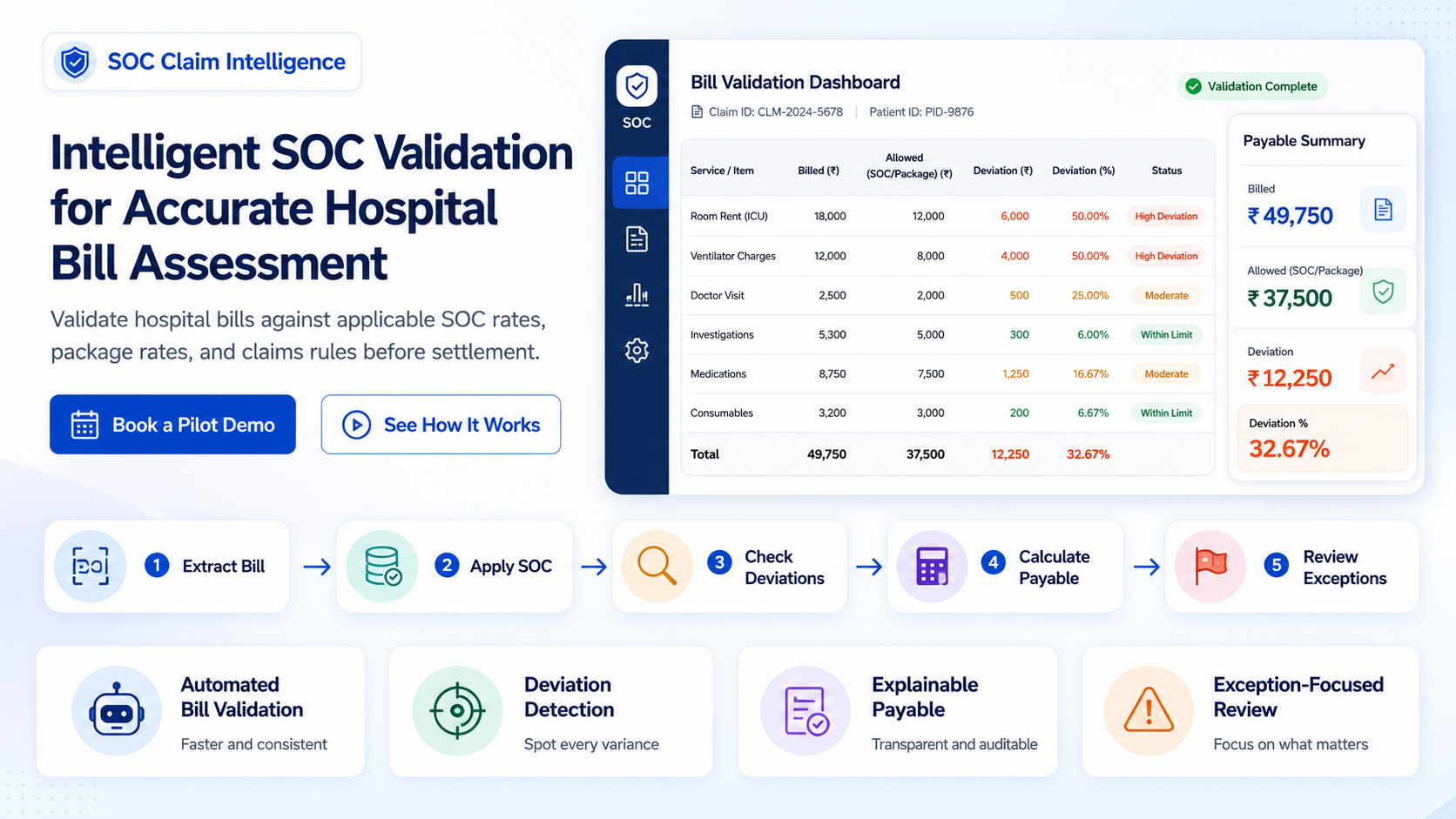
Validate Hospital Bills FasterAt a Glance
SOC Claims Intelligence on One Screen
How a claim file becomes structured line items, a routed schedule, a validated assessment, and a decision an auditor can follow.
Trust & Assurance
Built on Trust. Proven by Practice.
A platform that decides what a carrier pays has to be defensible on security, on compliance, and on the reasoning behind every flag it raises.
Each of these is a control your risk, compliance and IT teams can review before a single claim is processed.
Enterprise-Grade Security
AES-256 encryption at rest. TLS 1.3 in transit. SOC 2 Type II aligned controls. Your claim data never leaves your approved infrastructure boundary.
IRDAI Compliance Ready
Audit trails designed for IRDAI inspections. Every claim decision documented with timestamp, SOC version, and rationale.
99.5% Uptime SLA
High-availability architecture with automated failover. 4-hour RTO. Built for mission-critical operations.
Human-in-the-Loop
No black boxes. Every AI flag includes a plain-language explanation. Humans retain final decision authority on every claim.
DPDP Act Compliant
Patient data handling designed for India's Digital Personal Data Protection Act. Data residency controls included.
Insurance-Native
Built exclusively for insurance, not adapted from generic software. Deep domain expertise in Indian and global insurance operations.
How We Compare
Manual SOC Review vs Generic Claims Software vs SOC Claims Intelligence
| Capability | Manual Process | Generic CMS | SOC Claims Intelligence |
|---|---|---|---|
| AI document extraction (any format) | Keyed in by hand | Partial, format dependent | Any format, extracted and normalised |
| Line-item SOC validation | Checked line by line manually | Not supported | Every line-item validated automatically |
| Multi-SOC routing by region and provider type | Schedule chosen by the examiner | Not supported | Routed automatically to the applicable schedule |
| Duplicate detection with fuzzy matching | Only exact repeats get noticed | Not supported | Fingerprint and fuzzy matching across 180 days |
| Anomaly detection and provider risk scoring | Not practical at volume | Not supported | Provider profiles scored against peer baselines |
| Plain-language rejection notices | Drafted by hand, wording varies | Not supported | Generated with the reason for every deviation |
| Full audit trail per claim | Scattered across files and email | Partial activity logging | Timestamp, SOC version and rationale per decision |
| SOC version control and approval workflow | Whichever spreadsheet is current | Not supported | Versioned with four-eye approval |
| Integration with claims and payment systems | Not applicable | Depends on the vendor | Documented REST endpoints |
| Processing time per claim | Days | Minutes | Under 30 seconds |
The Difference
A manual process depends on how much of a hundred-page Schedule of Charges an examiner can hold in their head on their fortieth claim of the day.
A generic claims management system records the claim faithfully, but it has no view on what the charge should have been.
SOC Claims Intelligence reads the bill, applies the schedule that governs it, and puts every deviation in front of a human before the payment clears.
The platform validates and explains. It does not settle claims on its own — the examiner keeps final authority on every claim, including the ones the system clears.
Who It Is For
Built for Every Layer of the Insurance Value Chain.
Insurance Carriers
Validate provider bills against the applicable Schedule of Charges before settlement, not after the leakage shows up in the loss ratio.
Third-Party Administrators
Process high claim volumes for multiple carriers, each on their own schedule, without adding examiner headcount for routine checks.
Health Insurers
Check hospital bills line by line against network rates, package rates and quantity limits on every cashless and reimbursement claim.
Provider Network Teams
See how each empanelled hospital bills relative to its agreed schedule and to its peer group, with evidence for the next negotiation.
Claims Operations
Clear compliant claims automatically and route only genuine exceptions to reviewers, so capacity goes where judgment is needed.
Compliance & Internal Audit
Reconstruct any settlement decision with the SOC version, timestamp and rationale that applied at the time it was made.
Reinsurers
Rely on ceded claims that have been validated against a governed schedule rather than accepted on trust.
MGAs & Program Administrators
Apply the carrier's Schedule of Charges consistently across every program and every provider you administer.


Get Started
Ready to Stop Claims Leakage?
Book a 30-minute demo and we'll show you exactly how much your current process is costing, using your own claims volume as the baseline.
No obligation. We reply within one business day.
- Validate
- Detect
- Explain
Meet Our Innovators:
We aim to revolutionize how businesses operate through digital technology driving industry growth and positioning ourselves as global leaders.
Insurnest
Empowering insurers, re-insurers, and brokers to excel with innovative technology.
Insurnest specializes in digital solutions for the insurance sector, helping insurers, re-insurers, and brokers enhance operations and customer experiences with cutting-edge technology. Our deep industry expertise enables us to address unique challenges and drive competitiveness in a dynamic market.