Centralized Treaty Management for Reinsurance Operations
Treaty Management brings reinsurance structures, terms, participation, commission rules, calculation logic, and settlement conditions into one controlled platform.

Configured in one place
- Treaty structure
- Terms & conditions
- Participation
- Commission rules
- Calculation logic
- Settlement conditions
Property Quota Share — 2026
QS-2026-0184
Treaty structure & terms
- Structure
- Quota share
- Ceded share
- 35%
- Retention
- USD 5m
- Event limit
- USD 20m
- Ceding commission
- 27.5%
- Settlement
- Quarterly
Ceded premium = GWP × Ceded share
Gross written premium
USD 8,400,000
- Ceded premiumUSD 2,940,000
- Ceding commissionUSD 808,500
- v1
- v2
- v3
Illustrative treaty configuration. Structures, terms and formulas vary by agreement.
Why reinsurance teams use Treaty Management
- 01
Centralized Treaty Administration
Maintain treaty structures, terms, and financial conditions in one controlled workspace.
- 02
Configurable Treaty Calculations
Apply configured treaty formulas and rules consistently during premium and settlement processing.
- 03
Commission Management
Configure commission structures and calculation formulas against the relevant treaty.
- 04
Controlled Treaty History
Maintain clearer visibility into treaty changes, versions, and applicable terms.
The Problem
Spreadsheet-Led Treaty Administration Makes Reinsurance Calculations Difficult to Control
Reinsurance treaties contain detailed structures, financial terms, participation arrangements, commissions, calculation formulas, and settlement conditions.
When this information is maintained across spreadsheets, documents, and separate systems, reinsurance teams must manually interpret and apply the correct treaty terms during premium and settlement processing.
This increases administration effort and makes consistent calculation and reconciliation more difficult.
The manual loop
- Open treaty document→
- Interpret terms→
- Rebuild formula→
- Recalculate→
- Reconcile manually
Where treaty terms usually live
- Treaty slip — signed.pdfContractual terms
- Participation & shares.xlsxMaintained by operations
- Commission calc v7 FINAL.xlsxLocal formulas
- Amendment 02 — countersigned.pdfRevised terms
- Settlement workings Q3.xlsxReproduced each period
Problem Breakdown
Key Challenges in Reinsurance Treaty Administration
The challenge is not only storing the treaty. It is ensuring that the correct terms and formulas are applied consistently throughout its lifecycle.
Treaty Information Is Fragmented Across Multiple Records
Terms May Be Maintained Across Spreadsheets and Documents
Treaty structures, limits, commissions, conditions, and formulas may not exist in one structured record.
Teams Need to Refer Back to Source Documents
Operational users may repeatedly review treaty documents when processing premiums or settlements.
Different Teams Can Work From Different Information
Reinsurance, actuarial, finance, and operations teams may maintain separate working files.
Fragmentation Reduces Operational Visibility
Understanding the complete financial and contractual position becomes harder when data is spread across multiple sources.
Treaty Calculations Require Consistent Application of Complex Rules
Different Treaty Structures Use Different Calculation Logic
Quota share, surplus, retention, commissions, limits, and other structures can require different formulas.
Manual Formula Application Creates Error Risk
Incorrect formulas, percentages, or limits can affect ceded amounts and financial balances.
The Same Rules Need to Be Applied Repeatedly
Premium and settlement processing may require the treaty logic to be applied across many records.
Complex Wording Can Still Require Interpretation
Certain treaty conditions may need actuarial or reinsurance expertise before they can be configured correctly.
Commission and Settlement Calculations Create Repetitive Work
Commission Structures Can Vary by Treaty
Different contracts may use different commission rates, formulas, or conditions.
Calculations May Be Repeated Across Reporting Periods
Operational teams can spend significant time reproducing the same treaty calculations.
Manual Processing Makes Reconciliation Harder
Differences between expected and calculated amounts require additional checking.
Calculation Errors Can Affect Financial Positions
Incorrect treaty logic can flow through premium, commission, and settlement calculations.
Treaty Amendments and Versions Need Strong Control
Terms Can Change During the Treaty Lifecycle
Amendments may affect structures, percentages, limits, formulas, or settlement conditions.
Historical Terms Still Matter
Teams need to know which treaty conditions applied to a particular period or calculation.
Spreadsheet Versions Are Difficult to Govern
Multiple files can make it unclear which version contains the current approved terms.
Auditability Depends on a Clear Treaty History
Reinsurance and finance teams need visibility into how treaty terms and calculations changed over time.
Where this goes next
See how Treaty Management solves thisThe Solution
Manage Treaty Terms and Calculations Through One Structured Reinsurance Platform
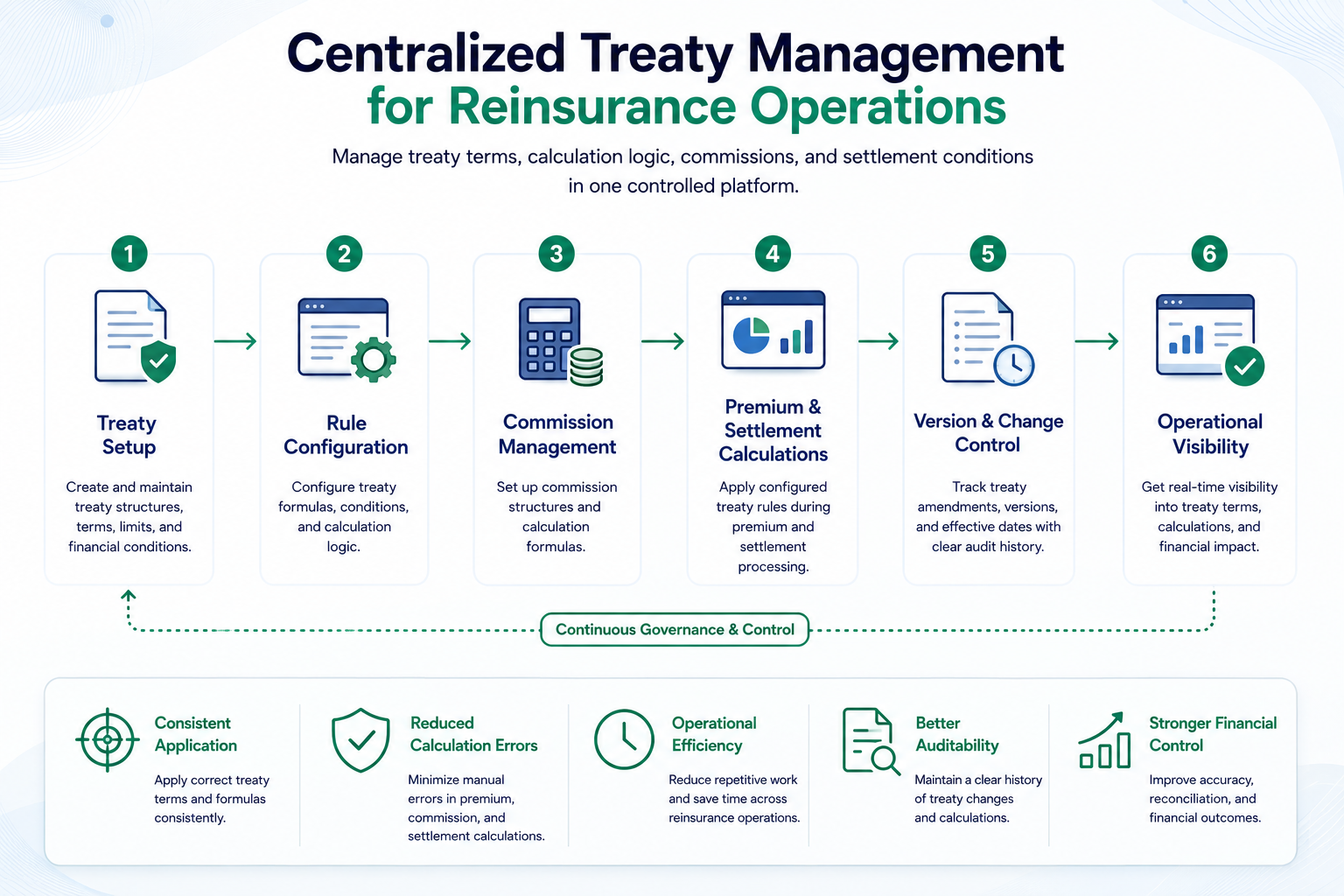
Treaty Management helps reinsurance teams manage treaty terms, commissions, settlement conditions, and calculation rules in one platform.
- 01
Structured Treaty Setup
Create a controlled digital record for each treaty.
Maintain the treaty structure, terms, limits, percentages, and other configured conditions in one place.
- 02
Treaty Rule Configuration
Translate agreed treaty terms into operational rules.
Configure the formulas and conditions used when treaty calculations are performed.
- 03
Commission Configuration
Maintain treaty-specific commission logic.
Configure applicable commission rates, formulas, and related conditions.
- 04
Premium & Settlement Calculations
Apply configured treaty logic consistently.
Use the relevant treaty rules during premium and settlement processing.
- 05
Treaty Version Control
Keep changes to treaty terms traceable.
Maintain controlled treaty versions as contractual terms are amended.
- 06
Centralized Treaty Visibility
Give operations and finance teams one structured treaty view.
Bring relevant treaty information and financial conditions together instead of relying on separate spreadsheets.
Business Impact
Business Impact of Manual Treaty Administration
Higher Administrative Effort
Teams spend time interpreting and applying treaty terms manually.
Repeated spreadsheet work increases the operational effort required to manage treaties.
Calculation Errors
Incorrect formulas or percentages can affect financial results.
Errors can flow through ceded premium, commissions, balances, and settlement calculations.
Inconsistent Treaty Application
The same terms may be applied differently across users or periods.
Manual interpretation makes consistency harder to maintain.
Slower Reconciliation
Financial differences require additional investigation.
When calculations are performed separately, teams spend more time validating and reconciling results.
Limited Treaty Visibility
Important contractual and financial information remains fragmented.
Teams may need to search several documents and files to understand the current treaty position.
Weak Version Control
Treaty amendments can create uncertainty around the applicable terms.
Poor version management makes historical calculations and audits harder to reconstruct.
Treaty terms should drive calculations consistently, not depend on manually maintained spreadsheets.
Core Capabilities
Core Capabilities of Treaty Management
A structured platform for treaty administration, calculation, and settlement processing.
Treaty setup
03Create the treaty record and its contractual foundation.
- 01
Treaty Creation
Create and maintain treaty records digitally.
Set up the relevant reinsurance agreement within a structured workflow.
- 02
Treaty Structure Management
Maintain the commercial structure of the agreement.
Configure the applicable treaty structure and related conditions.
- 03
Treaty Terms & Conditions
Keep contractual information connected to the treaty record.
Maintain relevant treaty terms required for operational processing.
Structure & financial terms
04Configure the values that shape every treaty calculation.
- 04
Participation & Share Configuration
Maintain the agreed allocation structure.
Configure relevant participation percentages or shares where applicable.
- 05
Retention & Limit Configuration
Apply the financial boundaries defined within the treaty.
Maintain configured retention, limits, and other relevant thresholds.
- 06
Commission Structure
Maintain applicable commission arrangements.
Configure the commission structure associated with the treaty.
- 07
Commission Formula Configuration
Apply the correct commission calculation logic.
Define formulas and conditions used during commission processing.
Calculation & settlement
04Apply configured treaty logic during processing.
- 08
Treaty Calculation Rules
Convert contractual terms into repeatable calculations.
Maintain the configured rules required for premium and related treaty calculations.
- 09
Premium Calculation
Apply treaty logic to premium processing.
Calculate relevant treaty shares and premium amounts based on configured terms.
- 10
Settlement Conditions
Maintain the rules governing settlement processing.
Configure relevant financial and contractual settlement conditions.
- 11
Settlement Calculation
Apply the correct treaty logic during settlement.
Use configured conditions and formulas to support settlement processing.
Control & traceability
03Keep treaty changes and results reconstructable.
- 12
Treaty Amendments & Versioning
Maintain control when treaty terms change.
Preserve the relevant treaty versions and changes for operational reference.
- 13
Calculation History
Keep results connected to the treaty logic used.
Maintain clearer visibility into calculations performed under the treaty.
- 14
Audit Trail
Improve traceability across treaty administration.
Support review of treaty information, changes, and calculation history.
How It Works
From Treaty Setup to Premium and Settlement Processing
- Create Treaty
- Configure Terms
- Define Rules
- Apply Calculations
- Produce Results
- Maintain Versions
- 01
Treaty Is Created
The reinsurance team creates the treaty record and enters the relevant agreement information.
- 02
Treaty Structure and Terms Are Configured
The applicable structure, shares, limits, retention, and other contractual terms are recorded.
- 03
Commission and Calculation Rules Are Defined
Applicable formulas, percentages, and calculation conditions are configured.
- 04
Settlement Conditions Are Configured
The relevant settlement rules and financial conditions are maintained against the treaty.
- 05
Treaty Rules Are Applied
Configured treaty logic is used during premium or settlement processing.
- 06
Calculated Results Are Produced
The system produces the relevant treaty calculation results based on the configured rules.
- 07
Treaty Changes Are Controlled
Where terms are amended, the applicable treaty version can be maintained for future processing and reference.
Next step
Manage Treaties With ControlAt a Glance
Centralized Treaty Management for Reinsurance Operations
Treaty terms, calculation logic, commissions, and settlement conditions held in one controlled platform.
Governance
Configured Automation With Actuarial and Reinsurance Oversight
Treaty Management automates calculations based on the treaty configuration entered into the platform.
The accuracy of the output depends on the accuracy of the treaty structure, terms, percentages, formulas, and source data configured in the system.
Complex treaty wording may still require interpretation before the appropriate calculation rule can be configured.
The platform applies the configured treaty logic consistently.
- Configured formulas
- Repeatable calculations
- Version-aware terms
- Calculation history
Your teams remain responsible for validating the treaty configuration and financial results.
- Actuarial
- Reinsurance
- Finance
- Operations
How We Compare
Spreadsheet Treaty Administration vs Structured Treaty Management
| Capability | Spreadsheet / Document Process | Generic Contract System | Treaty Management |
|---|---|---|---|
| Treaty creation | Manual files | Contract record | Structured reinsurance treaty setup |
| Treaty structure | Spreadsheet / document | Generic fields | Configured against treaty |
| Terms & conditions | Documents | Yes | Connected to operational calculations |
| Participation / shares | Manual | Limited | Configured treaty values |
| Retention / limits | Spreadsheet | Generic fields | Maintained within treaty structure |
| Commission structure | Manual | Limited | Treaty-specific configuration |
| Commission formulas | Spreadsheet formulas | No | Configurable calculation logic |
| Premium calculation | Manual / spreadsheet | No | Treaty rules applied |
| Settlement conditions | Document review | Generic | Configured against treaty |
| Settlement calculations | Manual | No | Rule-based processing |
| Treaty amendments | Multiple file versions | Document versions | Controlled treaty versioning |
| Calculation history | Separate files | No | Connected to treaty record |
| Auditability | Difficult to reconstruct | Contract history | Treaty + calculation traceability |
| Reinsurance focus | Manual process | Generic | Designed for treaty administration |
The Difference
A document records the treaty agreement.
A spreadsheet calculates the treaty values.
A generic contract system stores contractual information.
Treaty Management connects the reinsurance agreement with the operational rules required to calculate premium, commissions, shares, and settlements consistently.
It manages the treaty itself. It does not manage reinsurance claims.
Who It Is For
Designed for Reinsurance Treaty, Operations and Finance Teams
Reinsurance Companies
Centralize treaty administration and treaty-based financial calculations.
P&C Reinsurers
Manage treaty structures and calculation logic across general insurance portfolios.
Life & Health Reinsurers
Support life and health treaty administration and financial processing.
Specialty Reinsurers
Maintain complex treaty structures, terms, and calculations in a controlled environment.
Insurance Companies Managing Ceded Reinsurance
Maintain treaty information and calculations associated with transferred risk.
Reinsurance Operations Teams
Reduce spreadsheet dependency and repeated manual calculations.
Actuarial Teams
Validate treaty formulas, percentages, and calculation structures.
Reinsurance Finance & Settlement Teams
Use structured treaty information during commission, premium, reconciliation, and settlement processing.


Get Started
Strengthen Control Across Treaty Administration and Calculations
Centralize treaty terms, configure calculation rules, automate repeatable premium and settlement calculations, and maintain a clearer history across the treaty lifecycle.
- Configure the Treaty
- Apply the Rules
- Calculate With Control
Meet Our Innovators:
We aim to revolutionize how businesses operate through digital technology driving industry growth and positioning ourselves as global leaders.
Insurnest
Empowering insurers, re-insurers, and brokers to excel with innovative technology.
Insurnest specializes in digital solutions for the insurance sector, helping insurers, re-insurers, and brokers enhance operations and customer experiences with cutting-edge technology. Our deep industry expertise enables us to address unique challenges and drive competitiveness in a dynamic market.