Reinsurance Email Intelligence for Faster Underwriting Review
AI-powered Reinsurance Email Intelligence extracts and structures key underwriting data from submission emails and attachments before detailed risk review begins.

Reads across
- Email body
- PDFs
- Spreadsheets
- Claims files
- Supporting documents
- From
- submissions@broker.example
- Subject
- Property Cat XL Treaty — 2026 Renewal Submission
Please find attached the renewal submission for Cedant Mutual Insurance. The treaty incepts 1 April 2026 for a 12-month period, with a limit of USD 20m xs USD 5m. Estimated GWP is USD 8.4m and ceding commission is 27.5%. The five-year loss run and exposure schedule are attached.
- Treaty slip.pdf
- Exposure schedule.xlsx
- Loss run 2021-2025.xlsx
- Claims bordereau.pdf
Illustrative submission email. Formats and fields vary by cedant and broker.
Why reinsurance teams use Reinsurance Email Intelligence
- 01
Faster Submission Intake
Turn incoming reinsurance emails and attachments into structured submission information.
- 02
Reduced Manual Data Entry
Extract key underwriting data without repeatedly re-entering information into internal systems.
- 03
Consistent Submission Structure
Organize submissions from different cedants and brokers into a common format.
- 04
Underwriting-Ready Information
Bring treaty, premium, limits, commissions, claims history, risk, and supporting information into one structured view.
The Problem
Manual Submission Intake Delays Underwriting Before Risk Review Begins
Reinsurance submissions often arrive by email with spreadsheets, PDFs, claims files, and other supporting documents.
Teams must manually find, interpret, extract, and enter key information before underwriting can begin.
This creates unnecessary operational effort and delays risk assessment.
Today's manual path
- Find→
- Interpret→
- Extract→
- Re-enter
One submission, many documents
- Submission emailContext and commercial terms
- Treaty slip.pdfStructure and conditions
- Exposure schedule.xlsxSegments and territories
- Loss run 2021-2025.xlsxClaims and loss ratios
- Supporting documentsExclusions and annexures
Problem Breakdown
Key Friction Points in Reinsurance Submission Intake
The challenge starts before the underwriting decision. It begins with converting an unstructured submission into information that can actually be reviewed.
Submission Intake Requires Significant Manual Review
Submission Emails Need to Be Reviewed Individually
Teams may need to manually read each incoming email and understand the context of the submission.
Large Submission Packs Increase Review Effort
A single case may contain multiple spreadsheets, PDFs, claims files, and supporting documents.
Preparation Happens Before Underwriting
Underwriters or operations teams may spend time organizing information before the risk can even be assessed.
Higher Submission Volume Increases Administrative Work
As submission volumes grow, manual intake effort grows with them.
Critical Underwriting Information Is Fragmented Across Documents
Key Terms May Be Spread Across Multiple Files
Treaty structure, premium, limits, commissions, dates, and other commercial terms may not appear in one place.
Claims History Requires Separate Review
Historical claims, loss ratios, and related information may sit in spreadsheets or supporting documents.
Risk Information Can Be Buried Deep in the Submission
Exposure details, insured segments, territories, exclusions, and other risk information may require detailed document review.
Important Information Can Be Easy to Miss
When relevant data is spread across several documents, identifying every material field becomes more difficult.
Non-Standard Submissions Make Consistent Intake Difficult
Cedants and Brokers Use Different Formats
Submission structures can vary significantly depending on the organization sending the business.
Terminology Is Not Always Consistent
Similar treaty structures, financial terms, and risk information may be described differently.
Internal Teams Must Standardize the Information
Before comparison or underwriting review, teams may need to reorganize the incoming data into their preferred structure.
Every New Format Creates Additional Interpretation
A process that works for one submission format may still require manual adjustment for another.
Re-Keying and Incomplete Information Create Rework
The Same Information May Be Entered Again
Data extracted from emails and attachments often needs to be manually entered into underwriting, pricing, or internal reinsurance systems.
Manual Entry Creates Data Quality Risk
Premiums, dates, limits, commissions, claims values, and other figures can be entered incorrectly.
Missing Information Creates Follow-Up
Incomplete submissions require additional communication with the broker or cedant.
Fragmented Tracking Makes Readiness Harder to See
When submissions and follow-ups remain across shared inboxes and separate systems, it becomes harder to identify which cases are complete and ready for underwriting.
Where this goes next
See how Reinsurance Email Intelligence solves thisThe Solution
Convert Unstructured Reinsurance Submissions Into Structured Underwriting Data
Reinsurance Email Intelligence extracts key information from submission emails and attachments, organizing it for underwriting review.
- 01
Email & Attachment Intelligence
Process the complete incoming submission.
Review relevant information contained in the submission email together with supporting attachments.
- 02
Reinsurance Data Extraction
Capture the information required for underwriting preparation.
Extract cedant, broker, treaty structure, premium, limits, commissions, claims history, risk, dates, geography, and other available submission information.
- 03
Structured Submission Output
Standardize different submission formats.
Organize extracted information into a consistent structure for easier underwriting review.
- 04
Missing Information Identification
Identify submission gaps earlier.
Make incomplete or unavailable information easier to identify before detailed underwriting begins.
Structured Submission View
One organized starting point for underwriting
- 10 captured
- 2 gaps surfaced
- CedantCaptured
- Broker & ContactCaptured
- Treaty StructureCaptured
- Gross & Ceded PremiumCaptured
- Limits & Attachment PointCaptured
- Commission & Profit CommissionCaptured
- Claims HistoryCaptured
- Risk & ExposureCaptured
- Inception & Expiry DatesCaptured
- Territory & GeographyCaptured
- Loss RatiosGap
- Exclusions & ConditionsGap
- Extracted from the submission
- Surfaced as a gap for review
Illustrative structured output. Available fields depend on the submission received.
Business Impact
Business Impact of Manual Reinsurance Submission Intake
Slower Underwriting Preparation
Administrative intake delays the actual risk assessment.
Reading, organizing, and extracting information from complex submission packs consumes time before underwriting begins.
Higher Underwriting Workload
Skilled underwriting capacity is used for preparation work.
Manual extraction and data entry reduce the time available for risk analysis and underwriting judgement.
Data Entry Errors
Incorrect inputs can affect downstream analysis.
Manual re-entry of premium, limits, commissions, dates, or claims information creates avoidable data-quality risk.
Repeated Follow-Up
Incomplete submissions create additional work.
Missing information can result in repeated emails, document requests, and another round of review.
Inconsistent Submission Data
Different submission formats make standardized processing difficult.
Teams may need to interpret and reorganize every submission differently.
Limited Processing Capacity
Submission growth increases manual intake pressure.
When preparation remains people-dependent, scaling the underwriting operation becomes harder.
Underwriters should spend time assessing the risk, not rebuilding the submission.
Core Capabilities
Core Capabilities of Reinsurance Email Intelligence
From incoming email to structured underwriting information.
Intake
03Start from the submission as it arrives.
- 01
Reinsurance Email Reading
Start directly from the incoming submission.
Identify relevant submission information contained within the email body.
- 02
Attachment Processing
Include supporting documents in the same intake process.
Review relevant information contained in PDFs, spreadsheets, and other supporting files.
- 03
Attachment Identification
Maintain visibility into supporting documents.
Identify the attachments associated with the incoming submission.
Reinsurance Data Extraction
09Capture the fields underwriting preparation depends on.
- 04
Cedant Information Extraction
Identify the organization transferring the risk.
Extract available cedant information from the submission.
- 05
Broker Information Extraction
Capture broker and contact details.
Identify relevant broker and submission contact information.
- 06
Treaty Structure Extraction
Surface the proposed reinsurance arrangement.
Extract available treaty structure and related submission terms.
- 07
Premium Information Extraction
Bring key premium information into the structured view.
Capture available gross written premium, ceded premium, or related premium information.
- 08
Limits & Attachment Point Extraction
Surface important financial exposure terms.
Extract available limits, attachment points, and related figures.
- 09
Commission Information Extraction
Capture commercial terms from the submission.
Extract available commission and profit commission information.
- 10
Claims History Extraction
Bring historical loss experience forward.
Extract available historical claims, loss information, and loss ratios.
- 11
Risk & Exposure Information
Structure the underlying risk information.
Capture available insured segment, policy count, exposure, exclusions, conditions, and other risk-related information.
- 12
Dates & Geography
Keep timing and territorial information visible.
Extract available inception date, expiry date, period, territory, and geographical information.
Structured Output
02Hand underwriting one organized starting point.
- 13
Missing Information Identification
Surface gaps before detailed review.
Make missing or incomplete submission information easier to identify.
- 14
Structured Submission View
Create one organized starting point for underwriting.
Bring extracted information together into a consistent submission structure.
How It Works
From Incoming Submission to Underwriting-Ready Information
- Receive
- Read
- Extract
- Structure
- Identify Gaps
- Review
- 01
Submission Is Received
A cedant or broker sends the reinsurance submission through email with supporting documents.
- 02
Email Content Is Reviewed
The system identifies relevant information contained in the email body.
- 03
Attachments Are Processed
Relevant PDFs, spreadsheets, claims files, and supporting documents are reviewed as part of the submission.
- 04
Key Reinsurance Data Is Extracted
Cedant, broker, treaty structure, premium, limits, commissions, claims history, risk, dates, geography, and other available information are identified.
- 05
Submission Information Is Structured
Extracted information is organized into a consistent format.
- 06
Missing Information Is Identified
Important gaps or incomplete submission information are surfaced for review.
- 07
Structured Information Is Presented for Underwriting
The underwriting team receives an organized view of the submission as a starting point for detailed risk assessment.
Next step
Structure Submissions FasterAt a Glance
From Unstructured Submission to Underwriting-Ready Data
The five stages a cedant or broker submission passes through before it reaches the underwriting queue.
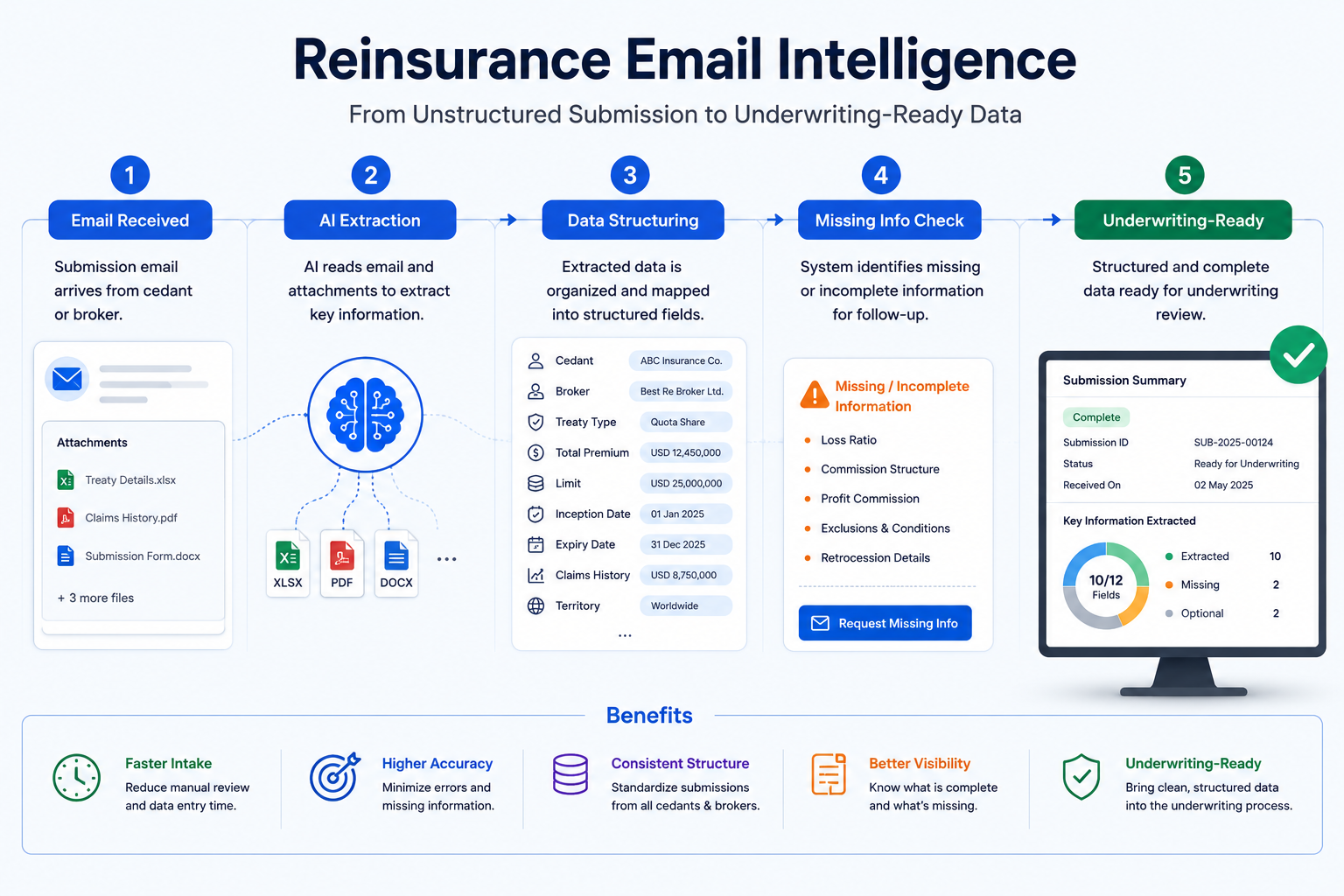
Human Review
AI Structures the Submission. Underwriters Retain the Decision.
Reinsurance Email Intelligence supports the submission intake and underwriting preparation stage.
It does not manage the reinsurance treaty and does not replace underwriting judgement.
Complex treaty structures, unusual terms, unclear wording, and material risk considerations still require experienced underwriting review.
The system reads, extracts, and structures the submission.
- Reads
- Extracts
- Structures
The underwriting team validates the information, assesses the risk, and makes the decision.
- Validates
- Assesses
- Decides
How We Compare
Manual Intake vs AI-Assisted Reinsurance Submission Intelligence
| Capability | Manual Email Intake | Generic Document AI | Reinsurance Email Intelligence |
|---|---|---|---|
| Submission email review | Human-led | General extraction | Reinsurance-focused intake |
| Attachment processing | Manual | Possible | Included in submission processing |
| Cedant information | Manual | Configurable | Structured extraction |
| Broker information | Manual | Configurable | Structured extraction |
| Treaty structure | Manual review | Generic extraction | Reinsurance-focused extraction |
| Premium information | Manual | Possible | Captured for underwriting review |
| Limits / attachment point | Manual | Possible | Structured extraction |
| Commission information | Manual | Possible | Captured from submission data |
| Claims history | Manual review | Possible | Included in structured output |
| Risk / exposure information | Manual review | Generic extraction | Structured for underwriting review |
| Dates / geography | Manual | Possible | Included in submission structure |
| Missing information visibility | Reviewer dependent | Requires setup | Surfaced during intake |
| Submission standardization | Manual | Generic output | Consistent reinsurance structure |
| Manual re-keying | High | Reduced | Designed to reduce repetitive entry |
| Reinsurance submission focus | Human process | Generic | Purpose-built for submission intelligence |
The Difference
Manual intake requires teams to find, interpret, and organize the submission themselves.
Generic document AI can extract text and fields.
Reinsurance Email Intelligence turns reinsurance emails and attachments into structured underwriting information.
It supports intake without managing treaties or replacing underwriting decisions.
Who It Is For
Designed for Reinsurance Submission & Underwriting Teams
Reinsurance Underwriting Teams
Reduce manual preparation before detailed risk assessment begins.
Reinsurance Companies
Create a more structured process for incoming reinsurance submissions.
Life & Health Reinsurers
Organize treaty, premium, claims, and risk information before underwriting review.
P&C Reinsurers
Support submission intake across property, marine, motor, engineering, casualty, agriculture, aviation, and other reinsurance lines.
Specialty Reinsurers
Prepare complex and document-heavy submissions for specialist underwriting review.
Reinsurance Brokers
Structure submission information more consistently before or during placement.
Cedant Reinsurance Teams
Support clearer and more structured reinsurance submission preparation.
Reinsurance Operations Teams
Reduce manual intake work and improve submission readiness for underwriting.


Get Started
Modernize Reinsurance Submission Intake
Convert incoming reinsurance emails and attachments into structured underwriting information before detailed risk review begins.
- Read
- Extract
- Structure
- Review
Meet Our Innovators:
We aim to revolutionize how businesses operate through digital technology driving industry growth and positioning ourselves as global leaders.
Insurnest
Empowering insurers, re-insurers, and brokers to excel with innovative technology.
Insurnest specializes in digital solutions for the insurance sector, helping insurers, re-insurers, and brokers enhance operations and customer experiences with cutting-edge technology. Our deep industry expertise enables us to address unique challenges and drive competitiveness in a dynamic market.