Reinsurance Bordereaux Calculation and Reconciliation
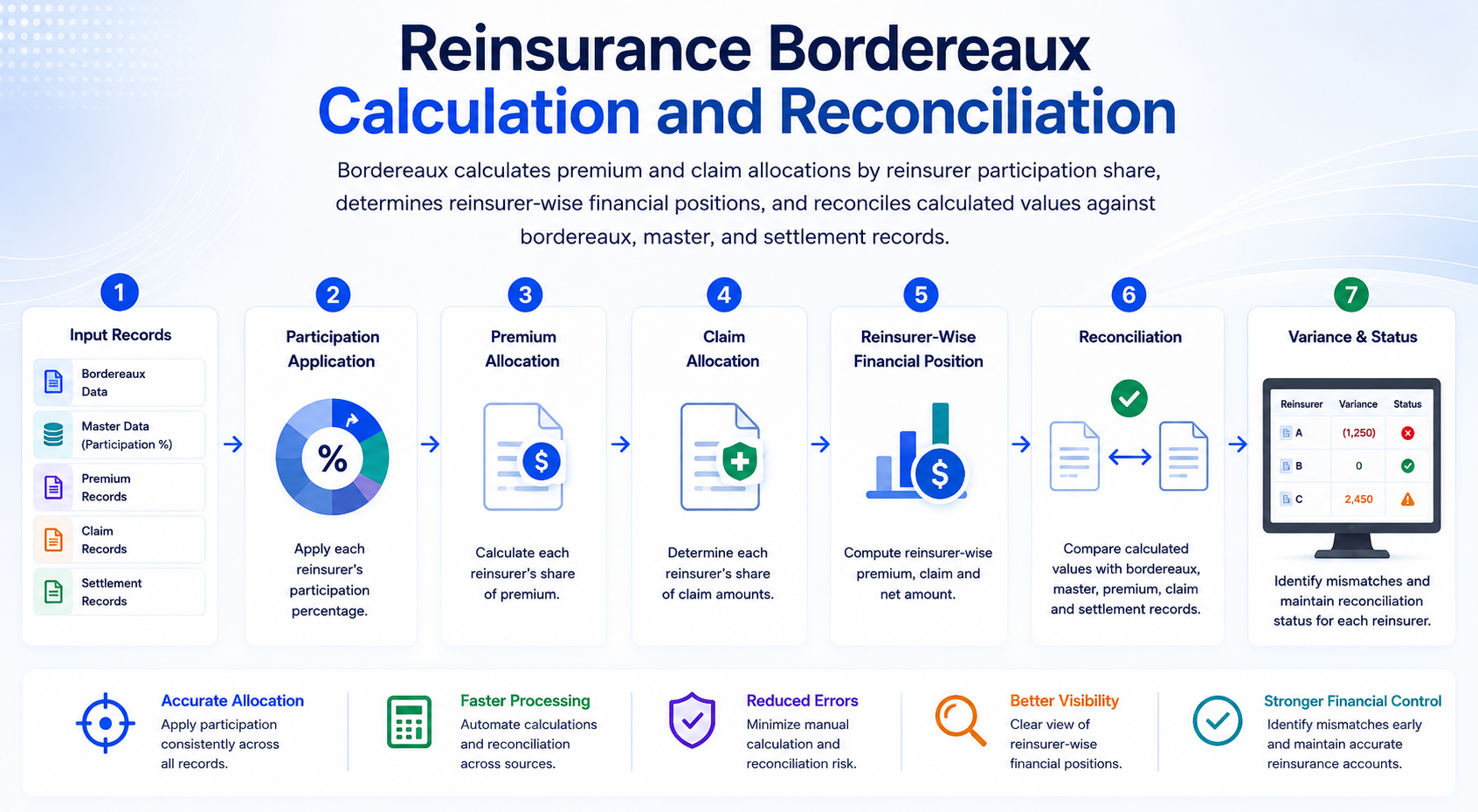
Bordereaux calculates premium and claim allocations by reinsurer participation share, determines reinsurer-wise financial positions, and reconciles calculated values against bordereaux, master, and settlement records.

Calculated and reconciled in one process
- Participation share
- Premium allocation
- Claim allocation
- Net position
- Bordereaux & master data
- Settlement records
Property Surplus Treaty — Q1 2026
Quarterly bordereaux — 4 participating reinsurers
BX-2026-0114
Bordereaux totals received
Amounts in GBP
- Premium
- 2,450,000
- Claims
- 1,180,000
Participation applied — reinsurer-wise position
| Reinsurer | Share | Premium | Claim | Net |
|---|---|---|---|---|
| MeridianMeridian Re— reconciled | 40.0% | 980,000 | 472,000 | 508,000 |
| AldgateAldgate Reinsurance— reconciled | 27.5% | 673,750 | 324,500 | 349,250 |
| NorthlineNorthline Re— reconciled | 20.0% | 490,000 | 236,000 | 254,000 |
| CastellanCastellan Re— variance to investigate | 12.5% | 306,250 | 147,500 | 158,750 |
| Allocated | 100.0% | 2,450,000 | 1,180,000 | 1,270,000 |
Allocated totals tie back to the bordereaux received
Reconciled against
- Bordereaux
- Master
- Premium
- Claim
- Settlement
Settlement variance — Castellan Re
Calculated net 158,750.00 against settlement record 154,000.00.
Difference4,750.00
Presented to reinsurance accounting for investigation
Illustrative reconciliation output. Participation, amounts and variances vary by treaty and bordereaux.
What Bordereaux calculates and reconciles
- 01
Premium Allocation
Calculate each reinsurer's share of premium based on configured participation percentages.
- 02
Claim Allocation
Determine each reinsurer's applicable share of claim amounts.
- 03
Reconciliation
Compare calculated values against bordereaux, master, premium, claim, and settlement records.
- 04
Variance Identification
Identify mismatches and maintain a clear reconciliation status for each reinsurer.
The Problem
Manual Reinsurance Allocation and Reconciliation Create Significant Financial Control Challenges
Reinsurance accounting requires accurate premium and claim allocation across participating reinsurers, followed by reconciliation against bordereaux, master, premium, claim, and settlement records.
Manual processes increase calculation errors, reconciliation time, and mismatch investigation.
The manual loop
- Open spreadsheets→
- Apply percentages→
- Allocate amounts→
- Compare records→
- Chase differences
An unexplained variance sends the whole allocation back for another recalculation
What reconciliation has to tie together
- Bordereaux statement — reinsurer submitted.xlsxLayout varies by reinsurer
- Master data — participation & sharesReference for every calculation
- Premium register — policy level.xlsxRecorded premium by policy
- Claim register — loss level.xlsxRecorded claim by loss
- Settlement advice — remittance.pdfAmounts actually settled
Problem Breakdown
Key Challenges in Bordereaux Calculation and Reconciliation
Accurate reinsurance accounting depends on both correct allocation and consistent reconciliation of the calculated results.
Reinsurer Participation Makes Allocation Complex
Each Reinsurer Can Have a Different Participation Share
Premium and claim amounts need to be distributed according to the agreed participation percentage of each reinsurer.
The Same Calculation Must Be Repeated Across Many Records
Large bordereaux can require repeated allocation across multiple premiums, claims, and reinsurers.
Manual Percentage Calculations Create Error Risk
An incorrect participation percentage can affect every amount attributed to that reinsurer.
More Reinsurers Increase Calculation Complexity
Multi-reinsurer arrangements create more financial positions that need to be calculated and checked.
Premium and Claim Values Need Reinsurer-Wise Validation
Premium Share Must Match the Configured Participation
Each reinsurer's premium amount needs to reflect the correct agreed share.
Claim Share Must Be Calculated Separately
Claims also need to be allocated using the relevant reinsurer participation.
Net Position Depends on Accurate Inputs
Incorrect premium or claim values can affect the calculated reinsurer-wise net amount.
Errors Can Flow Into Downstream Accounting
A calculation mistake can create mismatches later during reconciliation or settlement.
Multiple Records Need to Be Reconciled
Calculated Values Need to Match Bordereaux Records
The expected premium or claim allocation needs to be compared with the available bordereaux data.
Master Data Needs to Remain Consistent
Reinsurer participation and related reference information need to align with the calculation.
Premium and Claim Records Need Separate Reconciliation
Differences may occur independently across premium and claim data.
Settlement Records Need to Match the Calculated Position
The final financial position needs to be checked against the settlement information available.
Mismatches Require Time-Consuming Investigation
Differences Are Not Always Immediately Visible
Teams may need to compare multiple spreadsheets or records to find where a mismatch occurred.
One Variance Can Have Multiple Causes
The issue may come from participation percentage, premium amount, claim amount, master data, or settlement data.
Manual Reconciliation Creates Repeated Review
Every mismatch may require another round of checking and recalculation.
Reinsurer-Wise Status Can Be Difficult to Track
Without a structured reconciliation view, teams may struggle to see which reinsurers are matched and which still require investigation.
Where this goes next
See how Bordereaux solves thisThe Solution
Automated Reinsurer-Wise Allocation and Reconciliation
Bordereaux applies configured reinsurer participation percentages to premium and claim amounts, calculates each reinsurer's financial position, compares the calculated values with relevant source records, and identifies mismatches for review.
- 01
Participation-Based Allocation
Apply the agreed reinsurer share consistently.
Use configured participation percentages as the basis for premium and claim allocation.
- 02
Reinsurer-Wise Calculation
Calculate the financial position for each participating reinsurer.
Determine premium share, claim share, and relevant net amounts by reinsurer.
- 03
Multi-Level Reconciliation
Compare calculated values against the relevant records.
Reconcile against bordereaux, master, premium, claim, and settlement data.
- 04
Variance Identification
Bring mismatches forward for investigation.
Identify differences between expected and recorded values.
- 05
Reconciliation Status
Know which reinsurer positions are matched and which require review.
Maintain a clear reinsurer-wise reconciliation status.
Business Impact
Business Impact of Manual Bordereaux Reconciliation
Higher Finance Workload
Teams spend significant time calculating and comparing records manually.
Repeated allocation and reconciliation consume reinsurance accounting capacity.
Allocation Errors
Incorrect participation calculations can affect reinsurer-level balances.
A wrong percentage or input value can create incorrect premium or claim positions.
Slower Reconciliation
Multiple data sources make matching values time-consuming.
Teams may need to compare bordereaux, master, premium, claim, and settlement records separately.
Unresolved Variances
Mismatches can remain open when the source of the difference is unclear.
This can delay financial closure and settlement review.
Limited Reinsurer-Level Visibility
The overall position may be available without a clear participant-level status.
Teams need to know exactly which reinsurer records match and which do not.
Higher Rework
Corrections often require recalculation and another reconciliation cycle.
Manual processes increase the effort required when source data changes.
Reinsurance accounting is only reliable when calculated allocations and recorded values reconcile at the reinsurer level.
Core Capabilities
Core Capabilities of Bordereaux
From participation calculation to reinsurer-wise reconciliation status.
Allocation calculation
03Apply the agreed participation to premium and claim amounts.
- 01
Premium Allocation Calculation
Calculate premium distribution across participating reinsurers.
Apply each reinsurer's configured participation percentage to the relevant premium amount.
- 02
Claim Allocation Calculation
Calculate claim liability by reinsurer.
Apply the relevant participation percentage to claim amounts.
- 03
Reinsurer Participation % Calculation
Maintain the percentage that drives allocation.
Use the configured reinsurer participation as the basis for calculations.
Reinsurer-wise position
03Determine what each participant is owed or owes.
- 04
Reinsurer-Wise Premium Share
Show the premium attributable to each reinsurer.
Calculate and present the reinsurer-level premium amount.
- 05
Reinsurer-Wise Claim Share
Show the claim amount attributable to each reinsurer.
Calculate and present the reinsurer-level claim amount.
- 06
Net Amount Calculation
Determine the resulting reinsurer-level financial position.
Use the relevant premium and claim calculations to produce the applicable net amount.
Multi-level reconciliation
05Compare the calculated position against every relevant record.
- 07
Bordereaux Reconciliation
Compare calculated values with bordereaux records.
Identify differences between the expected allocation and recorded bordereaux information.
- 08
Master Data Reconciliation
Validate calculations against reference information.
Check relevant participation and master data used during calculation.
- 09
Premium Reconciliation
Compare calculated premium shares with available premium records.
Surface premium-level mismatches by reinsurer.
- 10
Claim Reconciliation
Compare calculated claim shares with available claim records.
Identify claim-level differences requiring review.
- 11
Settlement Reconciliation
Compare calculated financial positions with settlement records.
Identify differences between expected and recorded settlement values.
Variance & status
02Bring differences forward and keep the position visible.
- 12
Variance / Mismatch Identification
Bring reconciliation differences into one structured view.
Surface records where calculated and source values do not match.
- 13
Reinsurer-Wise Reconciliation Status
Track reconciliation at the participant level.
Show whether each reinsurer's relevant records are matched or require further investigation.
How It Works
From Reinsurance Data to Reconciled Reinsurer Position
- Data
- Participation
- Shares
- Net
- Reconcile
- Variance
- Status
- 01
Relevant Reinsurance Data Is Received
Premium, claim, participation, master, bordereaux, and settlement information is brought into the calculation process.
- 02
Participation Share Is Applied
The applicable percentage for each reinsurer is used to calculate its financial share.
- 03
Premium and Claim Shares Are Calculated
The system determines the premium and claim amounts attributable to each reinsurer.
- 04
Net Amount Is Calculated
The relevant reinsurer-level financial position is derived from the calculated values.
- 05
Calculated Values Are Reconciled
The system compares the expected amounts with bordereaux, master, premium, claim, and settlement records.
- 06
Variances Are Identified
Differences between calculated and recorded values are surfaced.
- 07
Reconciliation Status Is Presented
Each reinsurer's position is shown as matched or requiring further review.
End-to-end process flow
- Data→
- Apply Participation→
- Calculate Shares→
- Calculate Net→
- Reconcile→
- Identify Variance→
- Review Status
Next step
Reconcile Bordereaux FasterAt a Glance
Bordereaux Calculation and Reconciliation on One Screen
How input records become reinsurer-wise allocations, financial positions, and a reconciliation status per reinsurer.
Governance
Automated Calculation With Reinsurance Accounting Oversight
Bordereaux applies allocation and reconciliation logic based on the participation percentages and source information provided to the platform.
Incorrect participation percentages, master data, premium records, claim records, or settlement information can affect the resulting calculations and reconciliation status.
The platform calculates the allocation and identifies mismatches.
- Apply participation
- Calculate shares
- Reconcile records
- Identify variance
Your reinsurance teams review the source data and investigate exceptions where required.
- Reinsurance accounting
- Finance
- Settlement
- Reconciliation
How We Compare
Manual Bordereaux Reconciliation vs Structured Reinsurance Calculation and Reconciliation
| Capability | Manual Spreadsheet Process | Generic Finance Tool | Bordereaux |
|---|---|---|---|
| Reinsurer participation % | Manually maintained | Generic reference data | Used directly in allocation logic |
| Premium allocation | Spreadsheet formula | Requires configuration | Automated by reinsurer share |
| Claim allocation | Spreadsheet formula | Requires configuration | Automated by reinsurer share |
| Reinsurer-wise premium | Manual calculation | Generic accounting | Calculated by participant |
| Reinsurer-wise claim | Manual calculation | Generic accounting | Calculated by participant |
| Net amount | Manual | General ledger based | Calculated from reinsurer position |
| Bordereaux reconciliation | Manual comparison | Limited | Structured reconciliation |
| Master reconciliation | Manual | Possible | Included in reconciliation process |
| Premium reconciliation | Manual | Finance focused | Reinsurer-wise comparison |
| Claim reconciliation | Manual | Finance focused | Reinsurer-wise comparison |
| Settlement reconciliation | Manual | Generic | Compared against calculated position |
| Variance identification | Manual | Generic exception | Reinsurance-specific mismatch detection |
| Reconciliation status | Spreadsheet tracking | General status | Reinsurer-wise status |
| Reinsurance focus | Manual | Generic | Built around bordereaux allocation and reconciliation |
The Difference
A spreadsheet calculates individual values.
A finance system records financial transactions.
Bordereaux calculates reinsurer-wise premium and claim allocations and then reconciles those expected values against the relevant reinsurance records to identify mismatches.
The focus is not only calculation. It is proving that the calculated and recorded positions match.
The platform identifies the difference. Reinsurance accounting and finance teams determine the cause.
Who It Is For
Designed for Reinsurance Accounting and Reconciliation Teams
Insurance Companies Managing Ceded Reinsurance
Calculate and reconcile financial positions across participating reinsurers.
Reinsurance Companies
Maintain structured premium and claim allocation and reconciliation.
Cedant Reinsurance Teams
Validate reinsurer participation and resulting financial allocations.
Reinsurance Accounting Teams
Reduce spreadsheet-led allocation and reconciliation work.
Reinsurance Finance Teams
Identify mismatches across premium, claim, and settlement positions.
Settlement Teams
Compare calculated reinsurer positions against settlement records.
Reconciliation Teams
Track mismatches and reinsurer-wise reconciliation status.


Get Started
Strengthen Reinsurance Allocation and Reconciliation Control
Calculate premium and claim allocations by reinsurer share, reconcile the resulting values against reinsurance records, and identify mismatches before financial closure.
- Calculate
- Reconcile
- Identify the Difference
Meet Our Innovators:
We aim to revolutionize how businesses operate through digital technology driving industry growth and positioning ourselves as global leaders.
Insurnest
Empowering insurers, re-insurers, and brokers to excel with innovative technology.
Insurnest specializes in digital solutions for the insurance sector, helping insurers, re-insurers, and brokers enhance operations and customer experiences with cutting-edge technology. Our deep industry expertise enables us to address unique challenges and drive competitiveness in a dynamic market.