AI-Assisted Pet Claims Assessment for Faster, More Consistent Review
Pet Claims Assessment Tool structures claim evidence, identifies exceptions, and supports reimbursement assessment before final claims review.

Brought into one structured review
- Veterinary invoices
- Clinical notes
- Treatment history
- Claim information
- Policy details
- Reimbursement position
Bella — Golden Retriever, 4 yrs
Acute gastroenteritis — emergency consultation and treatment
PC-2026-4471
Documents received
- Vet invoicePDF
- Clinical notesPDF
- Treatment historyScan
Extracted from veterinary documents
- Treatment date
- 12 Mar 2026
- Diagnosis
- Acute gastroenteritis
- Procedure
- IV fluids, anti-emetic
- Claimed amount
- GBP 1,240.00
Exceptions surfaced for review
- Missing evidencePre-treatment consultation note not attached.
- Date inconsistencyInvoice dated 12 Mar; claim form states 14 Mar.
- Eligible treatment costGBP 1,240.00
- Policy excess− GBP 100.00
- Co-payment (20%)− GBP 228.00
74% of the claimed amount
Presented to the assessor for the final claim decision
Illustrative assessment output. Findings, policy terms and reimbursement outcomes vary by claim.
What Pet Claims Assessment Tool does
- 01
Veterinary Document Review
Extract relevant information from invoices, clinical notes, and supporting claim documents.
- 02
Missing Evidence Identification
Highlight missing or incomplete information before the claim progresses further.
- 03
Anomaly & Inconsistency Detection
Surface differences, unusual information, and risk indicators requiring claims-team attention.
- 04
Reimbursement Assessment Support
Bring claim evidence, policy information, and calculated reimbursement findings into one structured review.
The Problem
Manual Veterinary Document Review Slows Pet Claims Assessment
Pet insurance claims require reviewing veterinary invoices, medical records, treatment details, and supporting documents.
Claims teams must extract key information, identify missing evidence, compare records, and assess reimbursement before making a decision.
The manual loop
- Open documents→
- Locate information→
- Check evidence→
- Compare records→
- Calculate manually
Missing evidence sends the claim back for another cycle
What arrives with a pet claim
- Veterinary invoice — clinic issued.pdfFormat varies by provider
- Clinical notes — consultation.pdfFree-text medical detail
- Treatment history — scanned.jpgScanned or photographed
- Diagnostics & lab report.pdfAttached separately
- Claim form — submitted.pdfPolicyholder declared values
Problem Breakdown
Key Challenges in Pet Claims Assessment
The challenge is not simply reading the veterinary documents. It is connecting the medical evidence, claim information, and applicable policy details consistently.
Veterinary Documents Are Unstructured and Non-Standard
Different Clinics Use Different Formats
Invoices and medical records can vary significantly between veterinary providers.
Important Information Can Be Spread Across Multiple Documents
Treatment dates, diagnosis information, procedures, medicines, and costs may not appear in one place.
Clinical Notes Require Detailed Review
Relevant medical history may be contained inside lengthy veterinary notes.
Manual Extraction Takes Claims-Team Time
Assessors may need to locate and organize relevant information before they can begin the actual claim review.
Missing or Incomplete Evidence Delays Assessment
Claims May Arrive Without All Required Information
Supporting invoices, clinical notes, treatment history, or other evidence may be incomplete.
Missing Information May Be Identified Late
A reviewer may only discover a gap after spending time assessing the available documents.
Additional Evidence Creates Another Review Cycle
The team may need to request more information and reassess the claim when documents arrive.
Incomplete Evidence Makes Consistent Review Harder
Claims teams cannot assess the case confidently when relevant information is unavailable.
Medical History and Claim Information Need to Be Connected
Current Treatment May Need Historical Context
Earlier medical information can be relevant when reviewing the current claim.
Treatment Dates Need to Align Across Records
Differences between claim information, invoices, and clinical documentation may require investigation.
Pre-Existing or Historical Information Requires Careful Review
Potential historical conditions or related treatment need experienced claims or veterinary judgement.
Inconsistencies Can Be Difficult to Identify Manually
Relevant differences may be spread across several documents and claim fields.
Reimbursement Assessment Requires Multiple Checks
Claimed Costs Need to Be Reviewed Against Policy Information
The assessor needs to understand what amount may be considered under the applicable policy terms.
Exclusions or Limitations May Affect the Assessment
Relevant policy conditions need to be considered during review.
Manual Calculations Increase Assessment Effort
The reimbursement position may need to be calculated after reviewing multiple claim and policy inputs.
Different Reviewers Can Reach the Assessment Differently
Without a structured review process, similar claims can involve different levels of manual interpretation.
Where this goes next
See how Pet Claims Assessment solves thisThe Solution
Structure Veterinary Evidence Before the Claims Decision
Pet Claims Assessment Tool reviews veterinary documents, identifies missing or inconsistent information, and supports reimbursement assessment for claims teams.
- 01
Veterinary Document Intelligence
Turn unstructured documents into organized claim information.
Extract relevant details from veterinary invoices, medical records, and supporting documents.
- 02
Evidence Completeness Review
Identify what is missing before detailed assessment continues.
Surface incomplete or unavailable claim information and supporting evidence.
- 03
Anomaly & Inconsistency Review
Bring differences and unusual findings forward.
Highlight inconsistencies, anomalies, and relevant risk indicators for assessor review.
- 04
Policy & Claim Comparison
Connect the treatment evidence with the applicable claim context.
Support comparison of claim dates, treatment information, and relevant policy information.
- 05
Reimbursement Assessment
Support calculation of the potential reimbursement position.
Bring the applicable claim inputs together to assist the reviewer with reimbursement calculation.
Business Impact
Business Impact of Manual Pet Claims Assessment
Longer Claim Review
Claims teams spend time locating information before assessing the claim.
Manual review of veterinary invoices and medical records increases first-pass assessment time.
Higher Claims-Team Workload
Skilled assessors spend time on document administration.
Manual extraction and evidence checking reduce the capacity available for complex claims.
Repeated Follow-Up
Missing evidence creates additional communication and review.
Incomplete documentation can delay the claim and create another assessment cycle.
Inconsistent Assessment
Different reviewers may interpret the same information differently.
Unstructured documents and manual checks can create variation across claims teams.
Missed Anomalies
Relevant inconsistencies may remain hidden across multiple records.
Manual review makes it harder to identify every difference or risk indicator consistently.
Slower Reimbursement Assessment
Calculation starts only after the evidence has been organized and reviewed.
Manual document work can delay the point at which the payable position is understood.
Claims professionals should spend more time assessing complex cases and less time searching veterinary documents for information.
How It Works
From Pet Claim Documents to Structured Assessment Findings
- Receive
- Extract
- Check Evidence
- Identify Exceptions
- Assess
- Calculate
- Human Review
- 01
Claim Information Is Received
The pet insurance claim and available supporting information enter the assessment process.
- 02
Veterinary Documents Are Reviewed
The system processes relevant invoices, medical records, and supporting documents.
- 03
Medical and Financial Information Is Extracted
Relevant treatment, diagnosis, dates, charges, and other available information are structured.
- 04
Missing Evidence Is Identified
The system identifies missing documents or incomplete information requiring attention.
- 05
Anomalies and Inconsistencies Are Surfaced
Claim information and supporting evidence are reviewed for relevant differences, unusual findings, and risk indicators.
- 06
Policy and Reimbursement Information Is Assessed
Available treatment and claim information is compared with relevant policy data to support reimbursement calculation.
- 07
Structured Findings Are Presented
The claims team receives the extracted evidence, gaps, exceptions, and reimbursement findings in one review.
- 08
Claims Professional Makes the Decision
HumanThe insurer or MGA assessor validates the evidence, applies claims judgement, and makes the final claim decision.
Next step
Simplify Pet Claims ReviewAt a Glance
The Pet Claims Assessment Flow on One Screen
How a pet insurance claim moves from received documents to a reimbursement estimate the assessor can act on.
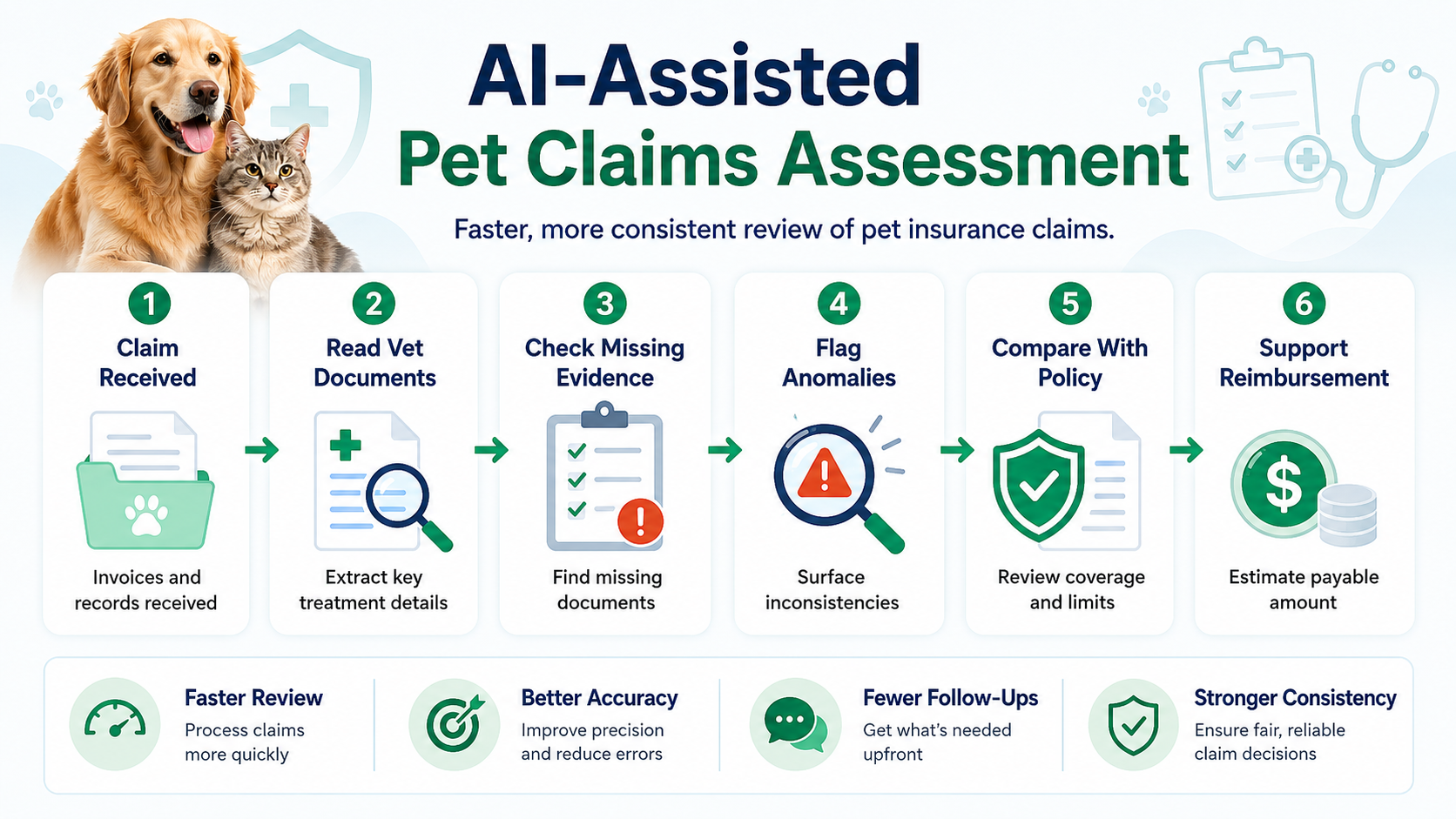
Human Oversight
AI Supports the Assessment. Claims Professionals Make the Decision.
Pet Claims Assessment Tool is designed to support document review, evidence identification, anomaly detection, and reimbursement assessment.
Veterinary coding can vary between clinics, and questions involving clinical causation, historical conditions, pre-existing conditions, or complex coverage interpretation still require experienced human judgement.
The platform extracts, structures, compares, and highlights findings.
- Extract
- Structure
- Compare
- Highlight
The insurer or MGA claims team interprets the evidence and makes the final decision.
- Claims assessors
- Veterinary review
- Claims operations
- Final decision
How We Compare
Manual Claims Review vs AI-Assisted Pet Claims Assessment
| Capability | Manual Claims Review | Basic OCR / Document Extraction | Pet Claims Assessment Tool |
|---|---|---|---|
| Veterinary invoice reading | Human-led | Yes | Structured claims extraction |
| Medical-record review | Manual | Text extraction | Relevant clinical information surfaced |
| Claim information connection | Manual | Limited | Connected to supporting evidence |
| Missing-document identification | Reviewer dependent | Limited | Surfaced during assessment |
| Missing-information checks | Manual | Limited | Structured gap identification |
| Anomaly detection | Reviewer dependent | No / generic | Claims-focused indicators |
| Inconsistency detection | Manual comparison | Limited | Cross-document comparison support |
| Historical medical information | Manual search | Extraction only | Brought into structured review |
| Policy information comparison | Manual | No | Included in claims assessment support |
| Exclusion / limitation review | Claims professional | No | Relevant conditions surfaced for review |
| Reimbursement calculation | Manual | No | Calculation support |
| Structured findings | Manually prepared | Extracted fields | Integrated assessment view |
| Final claim decision | Human | Human | Human |
The Difference
OCR extracts text from veterinary documents.
Manual claims review requires the assessor to locate, connect, compare, and interpret all of the evidence.
Pet Claims Assessment Tool goes beyond document extraction by organizing veterinary evidence, identifying missing information and inconsistencies, surfacing relevant claim indicators, and supporting reimbursement assessment in one structured review.
It supports the assessor. It does not replace claims judgement.
Who It Is For
Designed for Pet Insurance Claims and Veterinary Review Teams
Pet Insurance Companies
Support faster and more structured pet claim assessment.
Pet Insurance MGAs
Add AI-assisted claims review to pet insurance operations.
Claims Administrators
Reduce manual veterinary-document review and evidence checking.
Third-Party Administrators
Support structured pet claim assessment where claims administration is outsourced.
Pet Claims Teams
Focus assessor time on complex cases and exceptions.
Veterinary Review Teams
Use structured medical information as supporting evidence during claim review.
Claims Operations Teams
Reduce repetitive document extraction and missing-information checks.
Fraud / Investigation Teams
Use surfaced anomalies and inconsistencies as additional review signals.


Get Started
Strengthen Pet Claims Assessment Without Removing Human Judgement
Structure veterinary documents, identify missing evidence and inconsistencies, support reimbursement assessment, and give claims professionals a clearer starting point for every pet claim.
- Review the Evidence
- Surface the Exceptions
- Support the Decision
Meet Our Innovators:
We aim to revolutionize how businesses operate through digital technology driving industry growth and positioning ourselves as global leaders.
Insurnest
Empowering insurers, re-insurers, and brokers to excel with innovative technology.
Insurnest specializes in digital solutions for the insurance sector, helping insurers, re-insurers, and brokers enhance operations and customer experiences with cutting-edge technology. Our deep industry expertise enables us to address unique challenges and drive competitiveness in a dynamic market.