AI FNOL Voice Bot for Insurers

Stop Making FNOL Depend on Agent Availability

AI FNOL Voice Bot captures claim details, asks follow-ups, confirms information, and creates structured cases for claims teams.

What the FNOL Voice Bot changes

  • Less Waiting

    Customers can begin FNOL without waiting for the complete intake to be handled by an available agent.

  • Consistent FNOL Experience

    The same required intake logic can be applied across customer conversations.

  • Scalable Intake Capacity

    Handle changing or sudden claim volumes without making intake capacity depend only on available human bandwidth.

  • Structured Claims Handoff

    Claim details, FNOL report, call summary and transcript are available to the claims team.

The Problem

The Problem With Human-Led FNOL Today

FNOL happens at the moment when the customer needs the insurer to respond quickly and clearly.

But when the first loss conversation depends heavily on live agent availability, the experience is constrained by queues, human capacity, individual handling quality and manual information capture.

That creates four problems before the downstream claims process has even started.

See where it breaks down

Problem Breakdown

Where Human-Led FNOL Starts Breaking Down

These are structural risks of making claim intake depend on people, queues and individual handling quality.

  1. Longer Waiting Time

    The Claim Starts in a Queue

    When no agent is immediately available, the customer waits before the FNOL process can even begin.

    Peak Volumes Make Waiting Worse

    A sudden event or claim surge can create more FNOL calls than the available team can handle at the same time.

    Customer Time Is Lost Before Any Claim Work Starts

    Policyholders may spend valuable work or personal time waiting for someone to become available.

    Longer Queue and Handling Time Adds Cost

    More time spent waiting and handling repetitive intake can increase telephony and operating cost.

  2. Human Errors

    Agents Listen, Question and Document at the Same Time

    Important information can be missed, misunderstood or entered incorrectly while the conversation is happening.

    A Small Intake Error Creates Downstream Rework

    Incorrect or incomplete FNOL information can require correction, additional calls and manual follow-up.

    Errors Can Delay Claim Initiation and TAT

    Claims teams cannot move efficiently when basic information has to be corrected or completed later.

    Manual Handling Creates Governance and Data Risk

    Inconsistent capture and handling of customer information can increase compliance, regulatory and data-security exposure.

  3. The Customer Experience Is Not Universal

    The Experience Depends on Who Answers the Call

    One agent may provide a clear and supportive experience while another may rush, miss questions or document differently.

    The Same Claim Can Be Asked Different Questions

    Without a common intake logic, the depth and sequence of FNOL questioning can vary between representatives.

    Customers May Need to Repeat Their Story

    When information is not shared or captured consistently, the policyholder may have to explain the same loss again.

    Service Quality Changes With Shift, Workload and Experience

    The quality of the first claim interaction can vary with agent availability, workload and individual experience.

  4. Human-Led FNOL Does Not Scale Instantly

    Claim Surges Can Exceed Available Bandwidth

    Catastrophes, weather events or unexpected incidents can produce more FNOL demand than the current team can absorb.

    More Calls Usually Mean More Human Capacity

    A manual model increases intake capacity mainly by adding people, shifts or outsourcing support.

    Leaves and Attrition Directly Affect Service Capacity

    When trained staff are unavailable, customer waiting and service pressure can increase immediately.

    Capacity Is Hardest to Add When Customers Need It Most

    Recruiting, training and scheduling additional people cannot happen at the same speed as a sudden spike in claim volume.

The Solution

AI Voice Bot Built for FNOL

AI Voice Bot for FNOL that guides the customer through loss reporting, captures required claim information, asks relevant follow-up questions, confirms the details, and creates a structured case for the claims team.

  • Immediate Voice Intake

    Customers can begin reporting the claim sooner.

    The bot guides the policyholder through the initial loss-reporting conversation without making the entire FNOL intake dependent on an available human agent.

  • Consistent FNOL Logic

    The same required FNOL logic across conversations.

    Customer, policy, incident and loss information is collected through a defined intake framework instead of depending entirely on individual agent practice.

  • Contextual Follow-Up Intelligence

    Questions respond to the conversation.

    When required information is missing or an answer needs more detail, the bot asks relevant follow-up questions based on what the claimant has already provided.

  • Structured Claims Handoff

    The claims team receives more than a call recording.

    Captured information is organized into a structured claim case together with the FNOL report, call summary and transcript for downstream handling.

Demo

See the FNOL Voice Bot in Action

Watch how the FNOL Voice Bot captures claim information, asks relevant follow-up questions, confirms key details, and creates a structured FNOL case for the claims team.

Watch on YouTube

Business Impact

What This Costs the Claims Operation

  • Renewal & Retention Risk

    Bad claim experiences can directly affect customer loyalty.

    A poor experience at the moment of claim can influence whether the customer wants to continue the relationship.

  • Brand & Reputation Risk

    The first claim interaction becomes part of the insurer’s public reputation.

    Negative claim experiences can move beyond the individual customer through reviews, social media and word of mouth.

  • Claims TAT & Rework

    Errors at FNOL create work later in the claim journey.

    Missing or incorrect information can create repeated calls, corrections and additional handling before downstream claim work can continue.

  • Operating Cost & Capacity Pressure

    Human capacity becomes the throughput ceiling.

    Claims and customer-service teams spend skilled time on repetitive intake, while sudden claim volumes increase queue and staffing pressure.

  • Compliance & Data Risk

    The quality of control depends heavily on the individual interaction.

    Inconsistent manual collection can create additional exposure around required information, disclosures and customer-data handling.

  • Customer Trust

    The moment designed to prove the insurance promise can instead weaken it.

    Long waits, repeated questions and inconsistent service can make customers feel that their loss is not being treated with urgency.

Core Features

Core Features of the FNOL Voice Bot

Everything required to move from the first customer conversation to a structured FNOL case.

  • Voice-Based FNOL Conversation

    Natural loss reporting through a guided voice interaction

    Policyholders can explain what happened through a guided voice conversation while the bot captures the information required to initiate FNOL.

  • Context-Aware Follow-Up Questions

    The next question responds to what the customer has already said

    The bot asks relevant follow-up questions when information is missing, incomplete or needs additional clarification.

  • Structured Claim Information Capture

    Customer conversations are converted into usable FNOL data

    Customer, contact, policy, incident, location and loss information is organized into structured claim fields.

  • Customer Confirmation Before Submission

    Important claim details can be verified before FNOL moves forward

    The bot can summarize captured information back to the policyholder so key details can be confirmed before claim initiation.

  • Automated FNOL Case Creation

    The conversation becomes a structured starting point for the claim

    Captured information is organized into an FNOL case for downstream claims handling.

  • FNOL Report & Call Summary

    Claims teams receive structured information without rebuilding the conversation manually

    The system provides an FNOL report together with a concise summary of the customer interaction.

  • Full Conversation Transcript

    The complete context of the reported loss remains available

    Claims teams can access the full conversation when additional context is required.

  • Claim Reference & Next-Step Communication

    Customers can receive clarity on what happens after FNOL

    Where integrated with the insurer’s claims workflow, the bot can provide claim initiation confirmation, reference information and next-step guidance.

  • Claims-Team View

    Everything captured during FNOL can be available in one place

    Claims teams can review basic claim information, structured details, FNOL report, call summary and transcript from the same interaction.

How It Works

The Customer Speaks Naturally. The Claims Team Receives Structured FNOL Data.

  1. Customer Starts the Voice Conversation

    The claimant begins reporting the loss through the FNOL Voice Bot.

  2. Core Claim Information Is Captured

    The bot collects customer, contact, policy, incident and loss information required for the FNOL.

  3. Relevant Follow-Up Questions Are Asked

    The conversation adapts based on information already provided and collects missing or additional required details.

  4. Information Is Structured Into a Claim Case

    The customer’s conversational responses are converted into structured FNOL information.

  5. The Customer Confirms the Details

    Important claim information is summarized and confirmed before submission.

  6. Claim Filing Is Initiated

    Once the required FNOL information is captured and confirmed, the claim initiation process can continue.

  7. Claim Reference and Next Steps Are Provided

    Where applicable and integrated with the insurer’s claims process, the claimant can receive confirmation, reference information and guidance on what happens next.

  8. The Claims Team Receives the Complete FNOL Package

    Providers can review the structured claim details, FNOL report, call summary, transcript and other information captured during the interaction.

Process

  1. Speak
  2. Capture
  3. Follow Up
  4. Confirm
  5. Initiate
  6. Handoff

At a Glance

The FNOL Voice Bot Intake Flow on One Screen

From the customer reporting a claim to a structured FNOL case reaching the claims team.
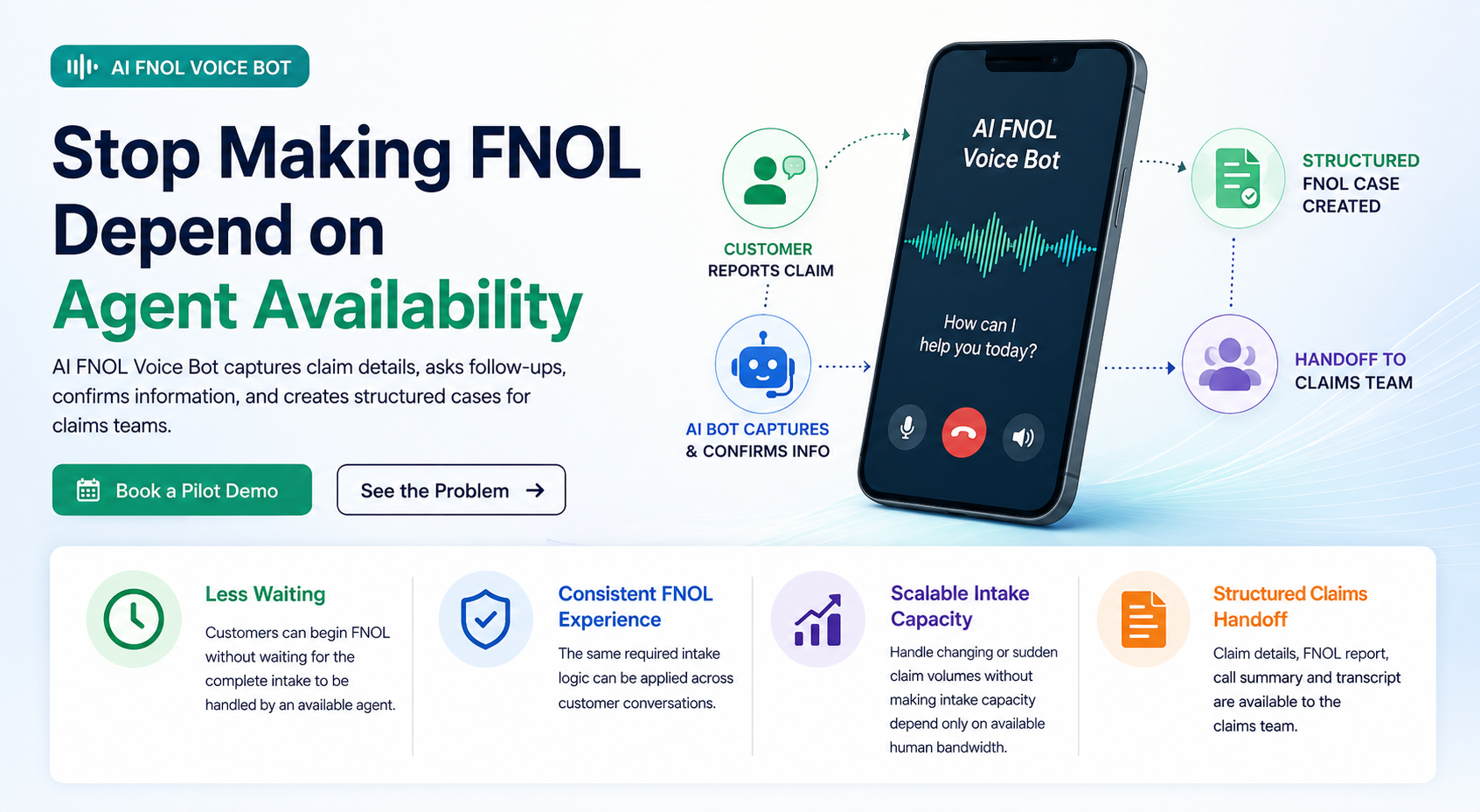
AI FNOL Voice Bot overview: a customer reports a claim to the voice bot, which captures and confirms the details, creates a structured FNOL case and hands off to the claims team — with less waiting, a consistent FNOL experience, scalable intake capacity and structured claims handoff.
Customer reports claim → Bot captures and confirms → Structured FNOL case → Claims team handoff

Expected Impact

Expected Operational Impact

A faster, more consistent and scalable FNOL process with less dependence on manual call handling, helping reduce customer waiting, repetitive intake work, human error and delays in claim initiation.

Helps Reduce

  • Customer waiting

  • Repetitive intake work

  • Human error

  • Delays in claim initiation

How We Compare

Most Intake Tools Help You Answer or Route the Call. The FNOL Voice Bot Is Designed to Deliver a Consistent, Scalable Starting Point for the Claim.

Swipe the table to compare →

How the Insurnest FNOL Voice Bot compares with manual FNOL calls, scripted IVR and generic voice AI.
CapabilityManual FNOL CallsScripted IVR / Voice MenuGeneric Voice AIInsurnest FNOL Voice Bot
Immediate voice-based FNOLDepends on agent availabilityMenu-drivenPossibleBuilt specifically around the FNOL conversation
Consistent customer experienceDepends on individual agentConsistent but fixed scriptDepends on configurationCommon FNOL intake logic across conversations
Scalability during claim surgesRequires more human capacityScalable menusScalable conversation layerVoice-based FNOL intake designed for changing claim demand
Insurance-specific FNOL data captureAgent-ledBasic predefined fieldsRequires configurationCustomer, policy, incident and loss information built into the workflow
Contextual follow-up questionsAgent-dependentFixed sequenceConfigurableFollow-ups based on information already provided
Required-information checkingManualLimitedRequires custom logicChecks whether required FNOL information has been captured
Customer confirmationAgent-dependentLimitedConfigurableImportant captured information can be confirmed before completion
Structured claim caseManually enteredLimitedRequires workflow configurationConversation converted into structured FNOL information
Claim-focused summary & transcriptDepends on agent notes and telephony setupLimitedGeneric output possibleFNOL-focused summary and full conversation context
Claims-team handoffAgent / system dependentRouting-focusedRequires integration designStructured details + FNOL report + summary + transcript
Designed specifically for FNOLHuman processScript navigationGeneral-purposePurpose-built flow from claim reporting to claims handoff

The Difference

  • Manual FNOL

    Depends on an available person.

  • Scripted IVR

    Moves the customer through a fixed script.

  • Generic Voice AI

    Can hold a conversation.

Insurnest FNOL Voice Bot

Designed to make the first claim interaction available, consistent, scalable and structured for the claims team.

Who It’s For

Who Can Use the FNOL Voice Bot?

  • Insurance Companies

    Build a faster, more consistent and scalable first-notice-of-loss process.

  • MGAs

    Reduce dependence on manual intake while maintaining structured claim capture.

  • Heads of Claims & Claims Leaders

    Increase FNOL capacity and improve consistency without making the process completely dependent on available claim handlers.

  • Claims Operations Teams

    Start downstream claim handling with structured information and conversation context.

  • Customer Service & Contact Centre Teams

    Reduce repetitive claim-intake calls, queue pressure and manual documentation.

  • Policyholders

    Report a loss through a guided voice conversation without making the first step of the claim depend entirely on agent availability.

Get Started

Make the First Claim Interaction Available, Consistent and Structured

The FNOL Voice Bot guides the policyholder through loss reporting, captures the required claim information, confirms the details, and hands the claims team a structured case.

See how it fits your FNOL process with a pilot demo built around your own intake requirements.

The Customer Speaks Naturally. The Claims Team Receives Structured FNOL Data.

Meet Our Innovators:

We aim to revolutionize how businesses operate through digital technology driving industry growth and positioning ourselves as global leaders.

circle basecircle base
Pioneering Digital Solutions in Insurance

Insurnest

Empowering insurers, re-insurers, and brokers to excel with innovative technology.

Insurnest specializes in digital solutions for the insurance sector, helping insurers, re-insurers, and brokers enhance operations and customer experiences with cutting-edge technology. Our deep industry expertise enables us to address unique challenges and drive competitiveness in a dynamic market.

Get in Touch with us

Ready to transform your business? Contact us now!
