AI-Assisted Fire Risk Prevention and Claims Assessment
Two connected tools support insurers before and after a fire, from identifying visible hazards during property inspection to analyzing post-loss damage for claims review.

Covered across the fire lifecycle
- Property inspection photos
- Visible fire hazards
- Corrective actions
- Fire-damage photos
- Burn and heat analysis
- Structured claim findings
Warehouse Unit B — commercial property
FR-2026-0148
Fire Risk Detector
Inspection reviewed
Inspection photos
12 framesVisible hazards identified
- Combustible storageCardboard stacked beside the heating unit.
- Blocked accessExtinguisher partially obstructed by pallets.
- Relocate
- Clear access
- Repair
Fire Claims Assessment Tool
Findings prepared
Damage photos
26 framesStructured damage findings
- Probable origin
- Storage bay, east wall
- Heat intensity
- High
- Fire spread
- Upward, along racking
Highest within the probable origin area
Presented to the internal risk and claims teams
Illustrative output. Findings vary by property, inspection evidence, and claim.
What the two fire tools do
- Pre-Loss
Pre-Loss Risk Detection
Identify visible fire hazards from property inspection photos before a loss occurs.
- Pre-Loss
Corrective Recommendations
Support risk improvement with clear actions such as removing, relocating, repairing, or reorganizing identified hazards.
- Post-Loss
Post-Loss Damage Analysis
Analyze fire-damage photos after inspection to support structured claim assessment.
- Post-Loss
Claims Review Support
Provide claims teams with structured findings on probable origin, burn severity, heat intensity, spread, and damage type.
The Problem
Fire Risk and Fire Damage Assessment Depend Heavily on Manual Visual Review
Property fire assessment happens before and after a loss.
Inspection teams identify visible fire risks, while claims teams assess damage from inspection photos. Both require consistent, careful image review.
The manual loop
- Capture photos→
- Open the image set→
- Review frame by frame→
- Interpret findings→
- Write up manually
Insufficient photographs send the team back for another inspection
What reaches the reviewer
- Pre-Loss
Property inspection photos
Reviewed by the risk or inspection team
Visible hazards can sit anywhere across the frames
- Post-Loss
Fire-damage inspection photos
Reviewed by the claims team
Burn, heat and smoke effects have to be separated manually
Problem Breakdown
Key Challenges Across Fire Risk and Claims Assessment
The challenge is different before and after the fire, but both stages depend on accurate interpretation of visual inspection evidence.
Visible Fire Hazards Can Be Difficult to Assess Consistently
Pre-LossRisk Conditions Can Vary Across Properties
Combustible materials, unsafe storage, electrical conditions, and access to fire-safety equipment can differ significantly from one site to another.
Inspection Photos Require Careful Review
Visible hazards may be spread across multiple images taken during the property inspection.
Important Conditions Can Be Overlooked
Small but relevant fire-risk indicators may receive different levels of attention depending on the reviewer.
Risk Recommendations Depend on What Is Observed
The quality of mitigation advice depends on correctly identifying visible hazards during inspection.
Risk Improvement Actions Need to Be Clear and Practical
Pre-LossIdentifying a Hazard Is Only the First Step
The inspection team also needs to determine what action should be taken.
Different Conditions Require Different Responses
Some risks may require removal, while others may require relocation, repair, or reorganization.
Manual Recommendations Can Vary
Different reviewers may describe similar corrective actions differently.
Follow-Up Depends on Clear Findings
Risk teams need understandable outputs that can be communicated back to the property owner or internal underwriting team.
Post-Fire Damage Photos Require Detailed Interpretation
Post-LossFire Damage Is Not Uniform
Different areas can show different burn patterns, heat exposure, smoke effects, and severity.
Direct Burn and Smoke Damage Need to Be Distinguished
Visible damage can result from direct flames, heat, smoke, soot, or combinations of these factors.
Probable Fire Origin May Require Careful Review
Inspection photographs can contain indicators that help claims teams understand where the fire may have started.
Contributing Materials Can Affect Damage Patterns
The materials present in the affected area can influence how the fire spread and how the damage appears.
Claims Assessment Depends on the Quality of Inspection Evidence
Post-LossPoor Photos Can Limit Assessment
Blurred, incomplete, poorly framed, or insufficient photographs may not provide enough information.
More Evidence May Be Required
Claims teams may need additional photographs before reaching a reliable view.
Manual Image Review Takes Specialist Time
Claims professionals need to assess multiple photographs and interpret different damage indicators.
Final Decisions Still Require Human Judgement
Image analysis can support the review, but the final claim assessment remains with the claims team.
Where this goes next
See how the two tools address thisSolution Overview
Two Tools Across the Fire Insurance Lifecycle
Two distinct tools work at different stages of the same lifecycle — one before the loss, one after it — each with its own workflow, input, and output.
Fire Risk Detector
Supports prevention and risk improvement during property inspection.
- Input
- Property inspection photos
- Output
- Visible hazards and corrective actions
Fire Claims Assessment Tool
Supports structured damage analysis after a fire has occurred.
- Input
- Fire-damage inspection photos
- Output
- Structured damage findings for claims review
- Pre-Loss
- Fire event
- Post-Loss
Pre-Loss Solution
Fire Risk Detector/Pre-Loss Risk Prevention
Fire Risk Detector analyzes property inspection photographs to identify visible conditions that may increase fire risk and provides corrective recommendations for internal review.
- Stage
- Pre-loss
- Input
- Property inspection photos
- Output
- Visible hazards and corrective actions
- Physical inspection
- Required
Capabilities
06What the tool surfaces from the inspection photographs
- 01
Visible Hazard Detection
Identify fire-risk conditions from inspection photos.
Analyze property photographs for visible conditions that may increase the likelihood or severity of a fire.
- 02
Combustible Material Detection
Identify combustible materials near potential ignition sources.
Surface visible situations where combustible items may be positioned too close to higher-risk areas.
- 03
Unsafe Storage Identification
Highlight storage conditions that can increase fire exposure.
Identify visible storage arrangements that may require corrective action.
- 04
Electrical & Fire Hazard Detection
Bring visible electrical and fire-safety concerns forward.
Surface relevant risk indicators visible within inspection photographs.
- 05
Fire-Safety Access Review
Identify blocked or difficult access to fire-safety equipment.
Highlight visible conditions that may affect access to fire-protection equipment.
- 06
Corrective Recommendations
Translate identified hazards into practical actions.
Recommend actions such as removing, relocating, repairing, or reorganizing the identified risk.
Pre-Loss Walkthrough
See the Fire Risk Detector Demo
Watch how inspection photographs are analyzed for visible fire hazards and turned into corrective recommendations for the risk team.

- Inspection images
- Hazard detection
- Corrective actions
Covered in the walkthrough
- Inspection images
- Hazard detection
- Corrective actions
After the walkthrough
Improve Fire Risk & Claims ReviewPre-Loss Business Impact
Business Impact of Inconsistent Pre-Loss Fire Risk Review
Missed Visible Hazards
Important fire-risk conditions may not receive consistent attention during manual review.
Inconsistent Risk Assessment
Different reviewers may interpret similar property conditions differently.
Higher Inspection Review Effort
Risk teams spend time reviewing multiple inspection photographs manually.
Slower Risk Improvement Follow-Up
Corrective action can be delayed when hazards and recommendations are not structured clearly.
Pre-loss inspection should not only document the property. It should clearly identify what requires attention.
Pre-Loss Process
How Fire Risk Detector Works
From Site Inspection to Corrective Recommendation
- Inspect
- Upload Photos
- Detect Hazards
- Recommend Action
- Review
- 01
Physical Site Inspection Takes Place
The internal inspection team visits the property and captures relevant photographs.
- 02
Inspection Photos Are Uploaded
The property images are provided to the Fire Risk Detector for analysis.
- 03
Visible Fire Hazards Are Identified
The AI reviews the photographs and highlights visible conditions that may increase fire risk.
- 04
Corrective Actions Are Recommended
The system suggests relevant actions such as removing, relocating, repairing, or reorganizing the identified hazard.
- 05
Internal Team Reviews the Findings
HumanThe risk, underwriting, or inspection team reviews the output and decides the appropriate next action.
- Inspect→
- Upload Photos→
- Detect Hazards→
- Recommend Action→
- Review
Next step
Improve Fire Risk & Claims ReviewAt a Glance
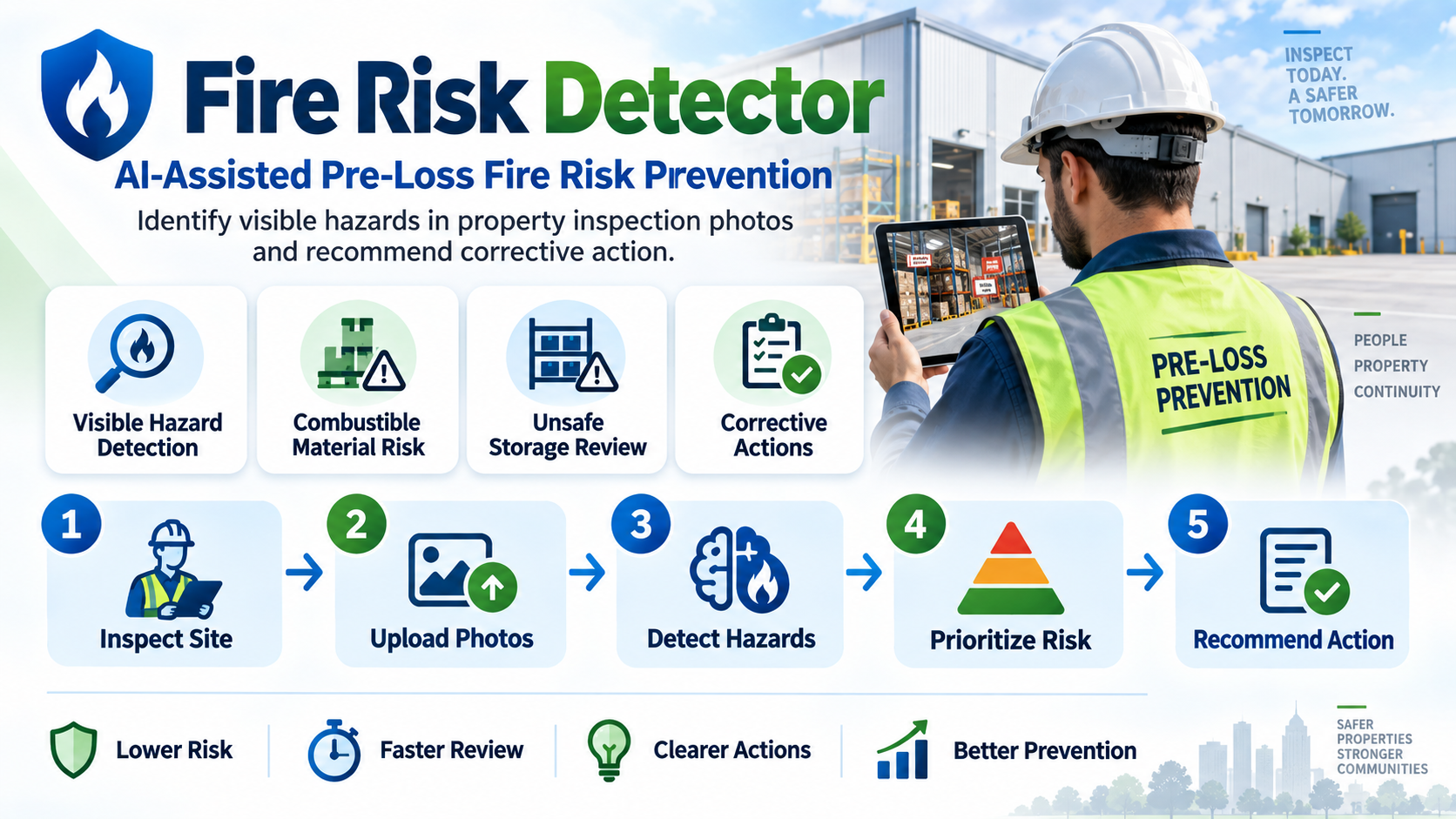
Fire Risk Detector on One Screen
From the site inspection through hazard detection and risk prioritization to the corrective action the risk team acts on.
- Pre-Loss
- Fire event
- Post-Loss
Post-Loss Solution
Fire Claims Assessment Tool/Post-Loss Claims Review
Fire Claims Assessment Tool analyzes photographs captured during the post-fire inspection and provides structured damage findings to support the claims team.
- Stage
- Post-loss
- Input
- Fire-damage inspection photos
- Output
- Structured damage findings
- Physical inspection
- Required
Capabilities
08What the tool prepares for the claims review
- 01
Probable Fire Origin Analysis
Support assessment of where the fire may have started.
Analyze visible patterns in inspection photographs that may help indicate the probable origin area.
- 02
Burn Severity Assessment
Classify the visible severity of fire damage.
Identify areas with differing levels of burn damage.
- 03
Heat Intensity Analysis
Assess visible indicators of heat exposure.
Support understanding of how intensely different areas may have been affected.
- 04
Fire Spread Analysis
Review how the fire appears to have progressed across the property.
Analyze visible patterns that may help claims teams understand the spread of damage.
- 05
Direct Burn Damage Identification
Separate direct fire damage from other visible effects.
Identify areas showing direct flame or burn damage.
- 06
Smoke & Soot Damage Identification
Distinguish smoke-related damage from direct burning.
Highlight areas primarily affected by smoke or soot.
- 07
Contributing Material Analysis
Identify visible materials that may have influenced damage.
Surface relevant materials present within affected areas for claims review.
- 08
Photo Quality Assessment
Know when the available evidence is not enough.
Identify poor-quality or insufficient photographs and indicate when additional images may be required.
Post-Loss Walkthrough
See the Fire Claims Assessment Demo
Watch how post-fire inspection photographs are reviewed for damage, checked for evidence quality, and presented as structured findings to the claims team.
- Damage analysis
- Evidence check
- Structured findings
Covered in the walkthrough
- Damage analysis
- Evidence check
- Structured findings
After the walkthrough
Improve Fire Risk & Claims ReviewPost-Loss Business Impact
Business Impact of Manual Fire Damage Review
Slower Damage Assessment
Claims teams need to review and interpret multiple inspection photographs manually.
Inconsistent Damage Interpretation
Different reviewers may assess severity or damage characteristics differently.
Higher Specialist Workload
Experienced claims professionals spend time on repetitive photo review.
Incomplete Evidence
Insufficient or poor-quality photographs can delay assessment and create another inspection follow-up.
Difficult Damage Classification
Burn, heat, soot, smoke, and spread patterns may require careful separation during claims review.
Slower Claim Triage
Claims teams may spend significant time understanding the visual evidence before deciding what requires deeper investigation.
Post-loss photographs should provide structured claim evidence, not another unorganized set of images to review.
Post-Loss Process
How Fire Claims Assessment Works
From Fire Inspection to Structured Claims Findings
- Fire
- Inspect
- Upload Photos
- Analyze Damage
- Check Evidence
- Review Findings
- 01
The Fire Occurs
A fire loss is reported and the internal claims process begins.
- 02
Physical Inspection Takes Place
The internal inspection or claims team visits the affected property and captures damage photographs.
- 03
Damage Photos Are Uploaded
The inspection photographs are provided to the Fire Claims Assessment Tool.
- 04
Fire Damage Is Analyzed
The system reviews probable origin, burn severity, heat intensity, fire spread, direct burn damage, smoke and soot damage, and relevant contributing materials.
- 05
Photo Quality Is Checked
The system assesses whether the photographs provide sufficient visual evidence and identifies when additional images may be required.
- 06
Structured Findings Are Presented
The claims team receives the AI-supported findings for further assessment.
- 07
Claims Team Reviews the Findings
HumanThe internal claims team applies its judgement and proceeds with the appropriate claim assessment.
- Fire→
- Inspect→
- Upload Photos→
- Analyze Damage→
- Check Evidence→
- Review Findings
Next step
Improve Fire Risk & Claims ReviewAt a Glance
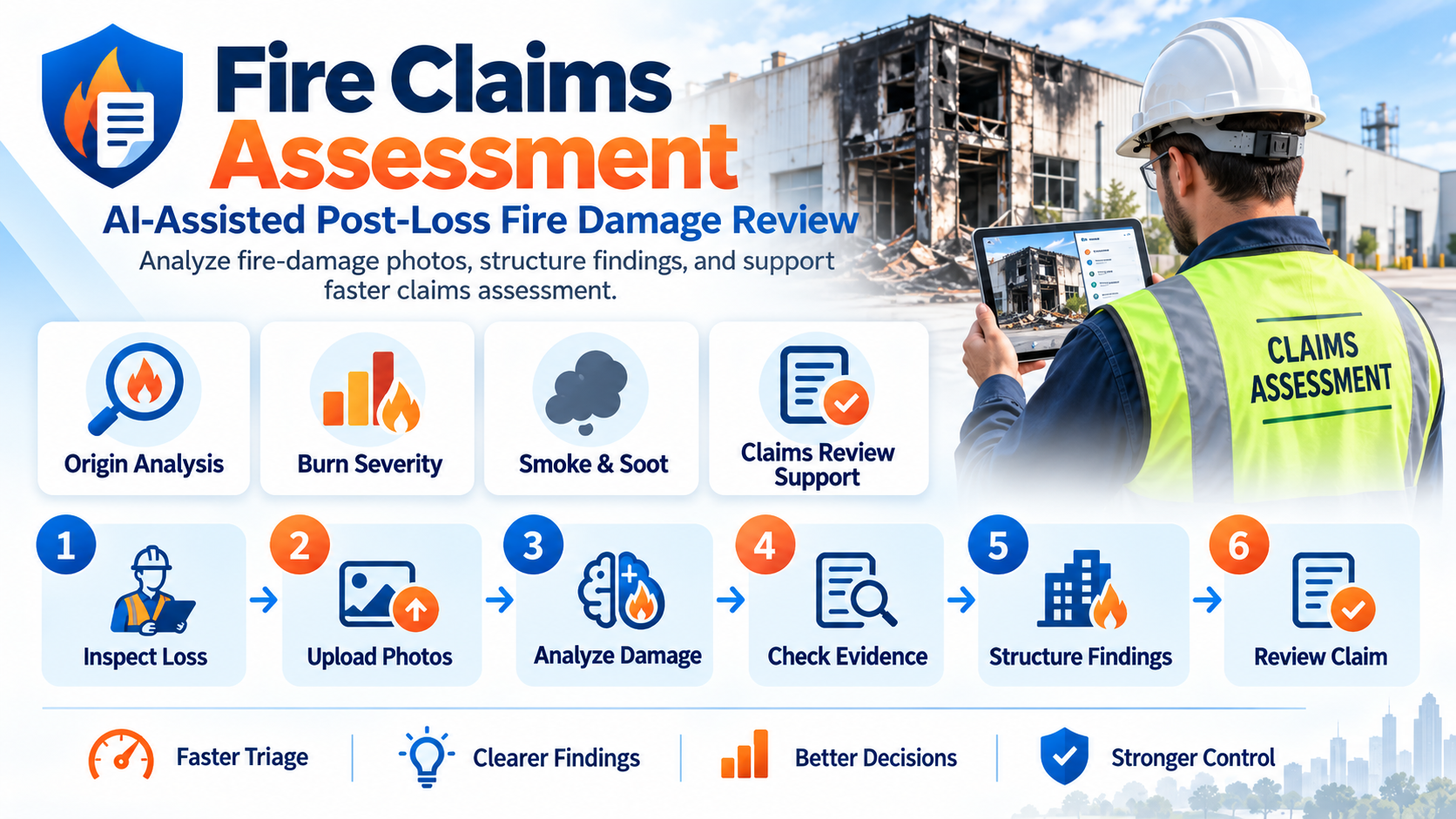
Fire Claims Assessment on One Screen
From the fire-damage inspection through to the structured findings the claims team reviews.
Human Oversight
AI Supports the Inspection Team. It Does Not Replace the Inspection.
Both Fire Risk Detector and Fire Claims Assessment Tool depend on physical site inspection.
The AI analyzes photographs captured by the internal inspection team and supports the review process.
- Pre-Loss
- Fire event
- Post-Loss
For Fire Risk Detector
The AI identifies visible hazards and suggests corrective actions.
- Identify hazards
- Suggest actions
For Fire Claims Assessment Tool
The AI analyzes visible damage characteristics and presents structured findings.
- Analyze damage
- Structure findings
Non-negotiable
- Physical inspection remains mandatory.Every finding on both tools starts from photographs captured on site by the internal inspection team.
- The final underwriting, risk, or claims decision remains with the insurer's internal team.The output is supporting information for review, not an automated decision.
Features Overview
Core Capabilities Across Both Tools
Two separate tools with separate inputs and separate outputs. The matrix shows exactly what each one covers.
| Capability | Pre-LossFire Risk Detector | Post-LossFire Claims Assessment Tool |
|---|---|---|
| Scope & Input | ||
| Stage | Pre-Loss | Post-Loss |
| Physical inspection | Required | Required |
| Input | Property inspection photos | Fire-damage inspection photos |
| Pre-Loss Detection | ||
| Visible hazard detection | Yes | No |
| Combustible material risk | Yes | No |
| Unsafe storage detection | Yes | No |
| Electrical / fire hazard detection | Yes | No |
| Fire-safety access issues | Yes | No |
| Corrective recommendations | Yes | No |
| Post-Loss Analysis | ||
| Probable fire origin | No | Yes |
| Burn severity | No | Yes |
| Heat intensity | No | Yes |
| Fire spread | No | Yes |
| Direct burn damage | No | Yes |
| Smoke / soot damage | No | Yes |
| Contributing material analysis | No | Yes |
| Evidence & Oversight | ||
| Photo quality assessment | Inspection photo analysis | Yes |
| Additional-photo requirement | Depends on inspection evidence | Can be identified |
| Human review | Required | Required |
How We Compare
Manual Image Review vs AI-Assisted Fire Inspection Analysis
| Capability | Manual Inspection Review | Generic Image Analysis | Fire Risk & Claims Intelligence |
|---|---|---|---|
| Physical site inspection | Required | Required | Required |
| Pre-loss hazard identification | Reviewer dependent | Generic object detection | Fire-risk focused analysis |
| Corrective recommendations | Manual | Limited | Based on identified visible hazards |
| Post-loss burn analysis | Claims specialist | Generic visual analysis | Fire-claim focused assessment |
| Probable origin support | Specialist review | Limited | Included in claims analysis |
| Burn severity | Manual | Generic | Structured assessment |
| Heat intensity | Manual interpretation | Limited | Included in damage analysis |
| Fire spread | Manual interpretation | Limited | Structured visual analysis |
| Smoke / soot differentiation | Manual | Generic | Included in claims review |
| Photo quality check | Manual | Possible | Part of evidence assessment |
| Need for more photos | Reviewer dependent | No | Can be identified |
| Final decision | Human | Human | Human |
The Difference
Physical inspection remains essential.
Manual inspection relies entirely on the internal team to interpret every photograph.
Generic image tools identify visual elements without insurance-specific context.
Fire Risk Detector supports pre-loss teams by identifying visible hazards and corrective actions.
Fire Claims Assessment Tool supports post-loss teams by analyzing fire-damage characteristics and organizing the findings for claims review.
Two separate tools. One connected fire insurance lifecycle.
Both tools support the inspection, risk, and claims teams. Neither replaces the site visit or the final decision.
Who It Is For
Designed for Property Risk and Fire Claims Teams
Property & Fire Insurers
Support pre-loss risk assessment and post-loss fire claim review.
General Insurance Companies
Add structured visual analysis to property inspection and claims workflows.
Commercial Property Insurers
Support fire-risk reviews across commercial locations and post-loss damage assessment.
Industrial Insurance Teams
Analyze visible site hazards and complex post-fire damage evidence.
Risk Engineering Teams
Use Fire Risk Detector during property inspection and risk-improvement review.
Underwriting Teams
Use structured pre-loss findings as supporting information during risk assessment.
Claims Teams
Use Fire Claims Assessment findings during post-loss review.
Loss Assessors & Internal Inspection Teams
Use AI-supported image findings alongside physical site inspection.


Get Started
Support Better Fire Risk Prevention Before the Loss and Better Assessment After It
Use Fire Risk Detector to identify visible hazards before a fire and Fire Claims Assessment Tool to analyze damage after a fire, while keeping physical inspection and final decisions with your internal team.
- Detect the Risk
- Assess the Damage
- Support the Decision
Meet Our Innovators:
We aim to revolutionize how businesses operate through digital technology driving industry growth and positioning ourselves as global leaders.
Insurnest
Empowering insurers, re-insurers, and brokers to excel with innovative technology.
Insurnest specializes in digital solutions for the insurance sector, helping insurers, re-insurers, and brokers enhance operations and customer experiences with cutting-edge technology. Our deep industry expertise enables us to address unique challenges and drive competitiveness in a dynamic market.