IRDAI Commission Rules 2026: Proposed Caps & Key Changes
On this page
- IRDAI Commission Rules 2026: Proposed Caps & Key Changes
- What Are the Proposed IRDAI Commission Rules 2026?
- Proposed IRDAI Commission Rules 2026 at a Glance
- What Are the Proposed IRDAI Commission Caps?
- Why Is IRDAI Reviewing Insurance Commissions?
- Is the Commission Issue Limited to Life Insurance?
- Why Can the Same Insurance Product Have Very Different Distribution Costs?
- Why Is Loan-Linked Insurance Receiving Particular Attention?
- Can Banks and NBFCs Require Customers to Buy Insurance With a Loan?
- How Could the Proposed Rules Affect Expenses of Management?
- What Counts as Commission Under the Proposed Framework?
- Why Does Persistency Matter to the Commission Debate?
- How Could Seller Accountability Change?
- How Could the Distribution Structure Change?
- Could Lower Commissions Affect Insurance Distribution?
- Does Lower Commission Mean Cheaper Insurance?
- Is Insurance Distribution Moving From Push to Pull?
- The Hidden Operational Challenge for Insurers Is Data
- Where Can Technology Help Insurers Adapt?
- From Commission Management to Distribution Intelligence
- How InsurNest Can Help
- What Should Insurers Watch Next?
- What Is the Bigger Question Behind the Reform?
- Sources
- Frequently Asked Questions
IRDAI Commission Rules 2026: Proposed Caps & Key Changes
IRDAI has proposed major changes to insurance commissions, distribution costs and intermediary accountability.
Here is what insurers need to know about the proposed commission caps, EoM changes and wider distribution reforms.
What Are the Proposed IRDAI Commission Rules 2026?
IRDAI's 2026 commission proposals seek to change how insurers remunerate distributors across different products and distribution channels.
The proposed framework introduces product- and channel-specific commission limits, tighter Expenses of Management (EoM) limits, greater transparency around distributor remuneration, stronger seller accountability and commission clawback where mis-selling is established.
There is one important point to understand first:
These are proposed changes under IRDAI's consultation paper, not final regulations.
IRDAI released the consultation paper, Recalibrating Economics of Insurance Distribution, in September 2026, with stakeholder comments invited until 25 October 2026.
So while people may search for the IRDAI commission rules 2026, insurers should currently treat them as proposals that may change before the final framework is issued.
Proposed IRDAI Commission Rules 2026 at a Glance
The consultation proposes changes across several areas of insurance distribution.
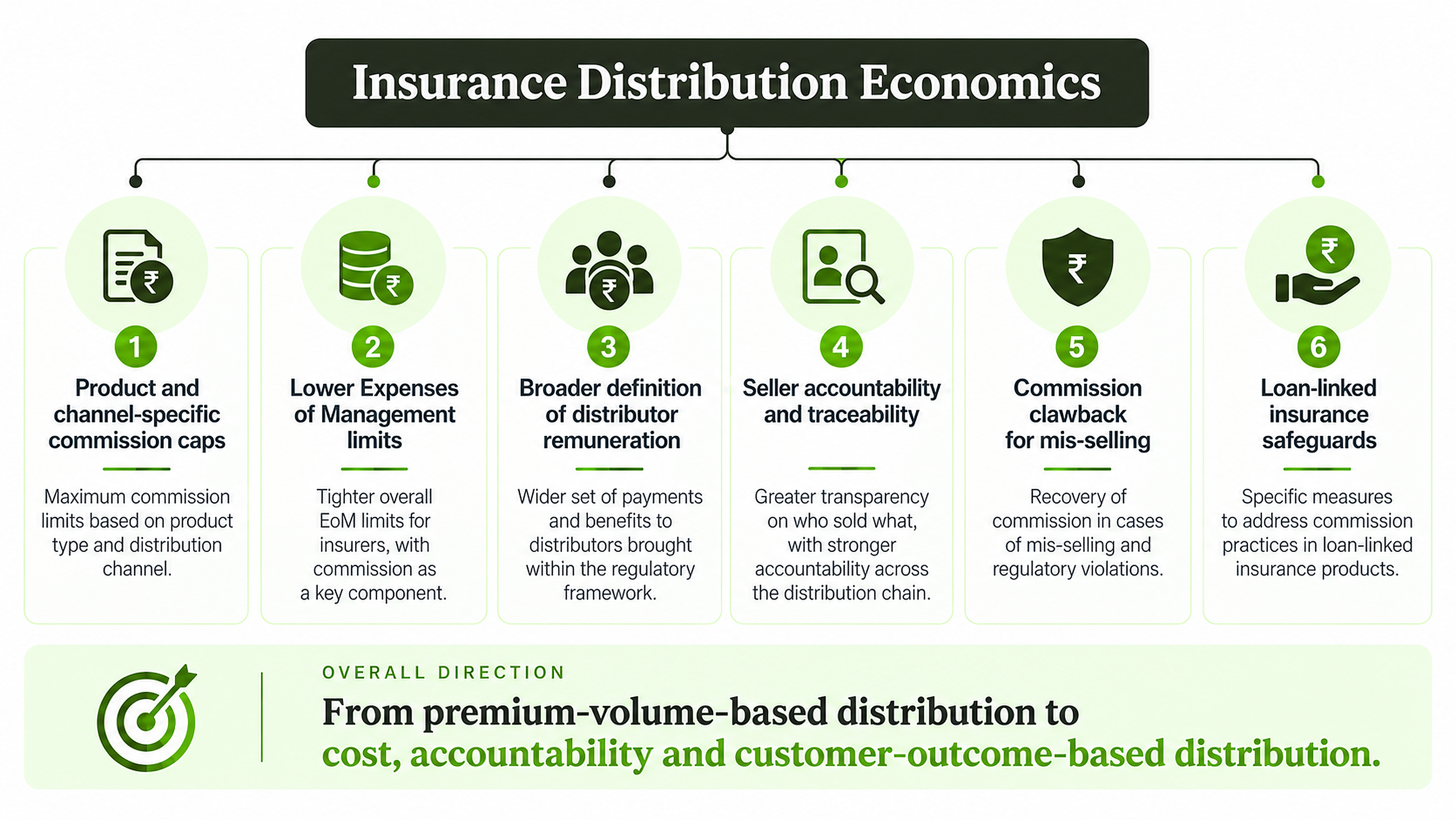
| Area | What IRDAI is proposing |
|---|---|
| Commission limits | Different maximum commissions based on product, channel and distribution structure |
| Expenses of Management | Lower overall EoM limits for insurers, and a lower regulatory fee |
| Remuneration | Direct, indirect, monetary and non-monetary remuneration to be counted as commission |
| Transparency | Greater disclosure of commission policies and costs |
| Audits | Annual cost audits for insurers and specified large distributors |
| Mis-selling | Commission clawback where mis-selling is established |
| Seller accountability | Stronger linkage between an individual seller and the policy sold |
| Bank and NBFC incentives | Restrictions on volume-linked and reward-linked incentives |
| Loan-linked insurance | Restrictions on compulsory bundling of insurance with loans |
| Distribution structure | Three broad categories of distributors and a greater role for digital distribution |
| Digital practices | Action against dark patterns on insurance websites and apps |
The central idea is that distribution remuneration should better reflect the segment, line of business, channel, product complexity and actual effort involved in selling and servicing insurance.
What Are the Proposed IRDAI Commission Caps?
The consultation paper proposes different maximum commission levels depending on the insurance product and type of distributor.
| Insurance Product | Distribution Entities | Agents |
|---|---|---|
| Individual life, premium term of 10+ years, first year | 20% | 25% |
| Individual life, premium term below 5 years, first year | 5% | 6.25% |
| Single-premium term insurance sold by lenders with a loan | 2% | Not applicable |
| Individual health insurance, first sale | 15% | 20% |
| Individual health insurance, renewal or porting | 5% | 10% |
| Motor third-party insurance, new vehicle | Nil | 2.5% |
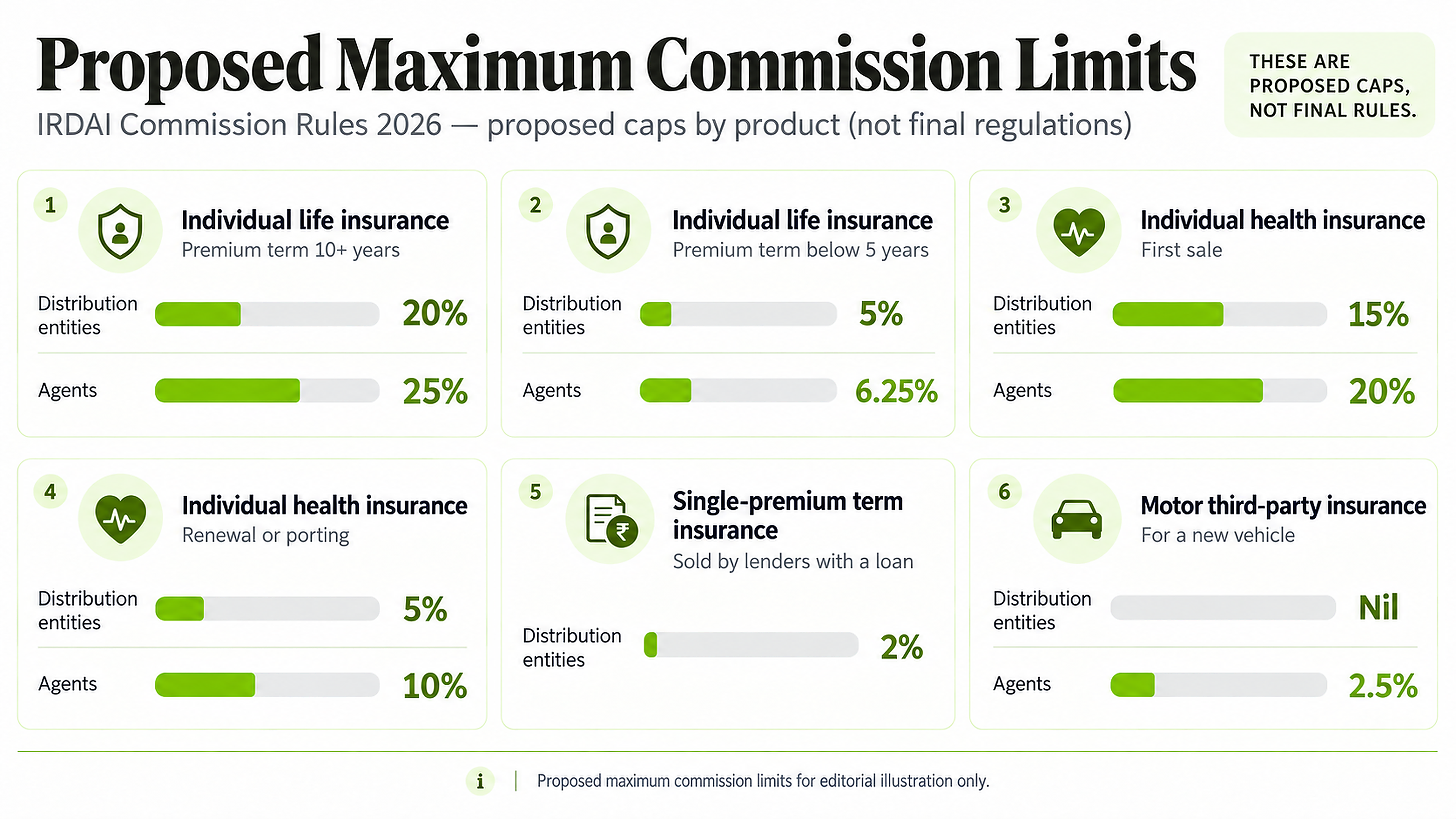
These percentages are proposed maximum commission limits, not mandatory rates that every insurer must pay.
The framework also proposes:
- increasing renewal commission for certain longer-term life policies from the sixth year, by 0.5 percentage points every three years, up to a maximum of 7%
- nil or very low commission on certain mandatory or near-mandatory products
- higher commission limits for closed architecture distributors, such as agents tied to one insurer, than for open architecture distributors
- additional rewards above normal limits for business from rural areas, towns with a population up to 50,000 and smaller cities with a population up to 10 lakh
The commission table, however, is only one part of the reform.
The bigger question is:
Why does IRDAI believe insurance distribution economics need to change?
Why Is IRDAI Reviewing Insurance Commissions?
One reason becomes clear when premium growth is compared with the growth in distributor remuneration.
IRDAI examined a representative sample covering approximately 92% of life insurance premium procured through corporate agents.
Over the period reviewed:
- new business premium increased around 28%, from approximately ₹63,000 crore to ₹80,000 crore
- distributor remuneration increased approximately 125%, from around ₹9,580 crore to ₹21,600 crore
- distributor remuneration reached close to 27% of first-year premium
- rewards and incentives could add another 30% to 60% over base commission
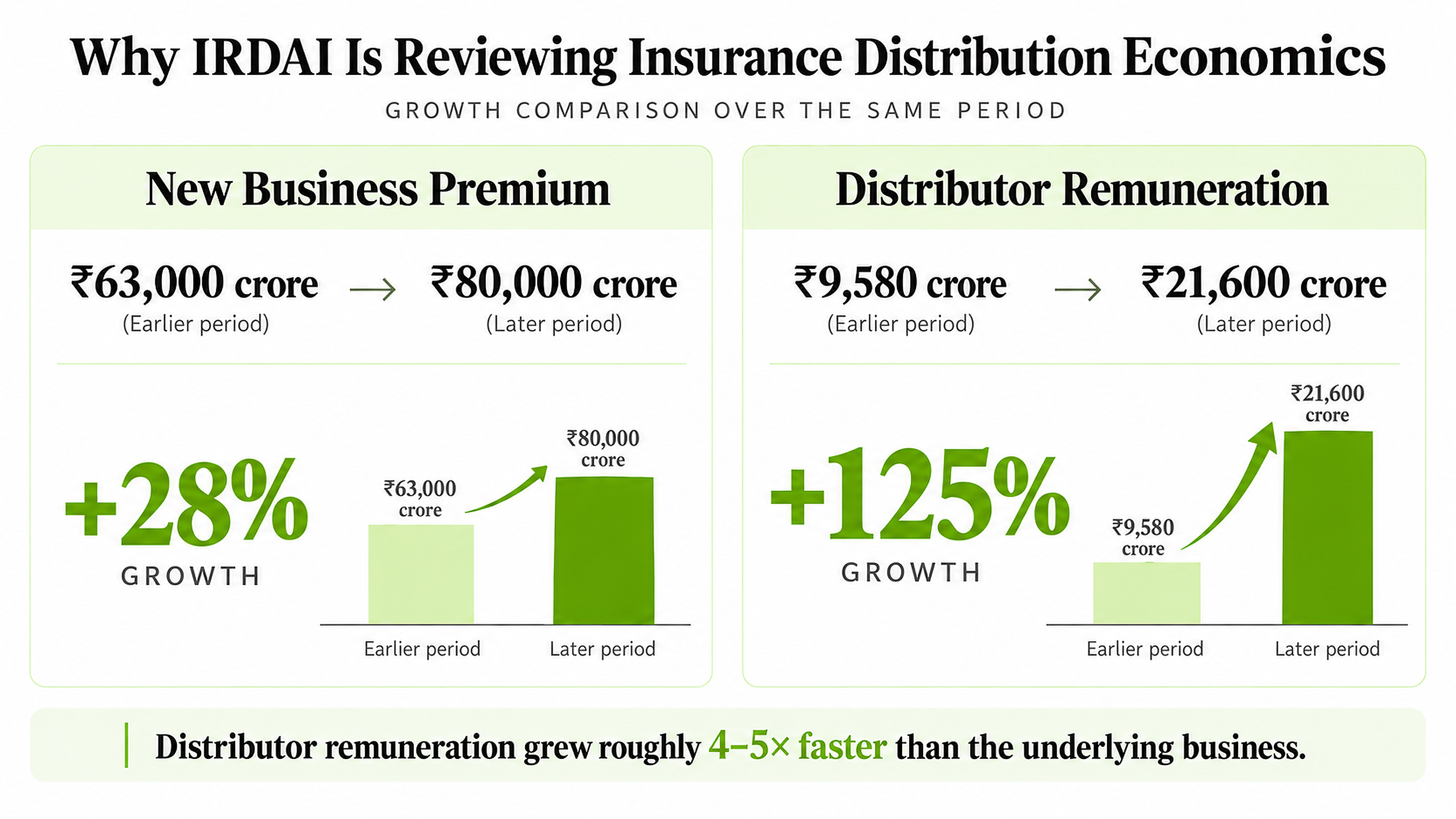
IRDAI describes remuneration as growing four to five times faster than the underlying business.
That creates a fundamental question:
If distribution remuneration is increasing much faster than the business generated, what is the additional cost paying for?
IRDAI's proposed framework attempts to connect remuneration more closely with the actual work performed by the distributor and the longer-term outcome of the business.
Is the Commission Issue Limited to Life Insurance?
No.
IRDAI's analysis also identifies significant changes in commissions within general insurance distributed through brokers.
Premium placed through brokers increased approximately 37%, from around ₹74,460 crore to ₹1,01,862 crore.
Over the same period, broker commission including rewards increased approximately 173%, from ₹6,348 crore to ₹17,348 crore.
The average commission rate increased from approximately 8.5% to 17%.
Motor and health insurance show particularly large differences between premium and commission growth.
Motor Insurance
Motor premium increased around 34%, while commission increased approximately 259%.
Average commission rates increased from around 9% to 25%.
Health Insurance
Premium distributed through brokers increased approximately 53%, while broker commission increased around 118%.
Average commission rates in retail health increased from roughly 10% to 30%.
This helps explain why IRDAI's review goes beyond life insurance and examines the broader economics of insurance distribution.
Why Can the Same Insurance Product Have Very Different Distribution Costs?
Another issue highlighted in the consultation paper is the difference in remuneration across distribution relationships.
Banks account for around 45% of private life insurers' total premium, making bancassurance particularly important.
According to the consultation data:
- banks with a single insurer tie-up received average total payouts of around 13% of life new business premium
- banks with multiple insurer relationships received approximately 33%
- some multiple tie-up arrangements reached as high as 72%
- the largest private life insurer paid its promoter bank, which has a single tie-up, a total of 8% of first-year premium, while the second-largest paid its promoter bank, which has multiple tie-ups, 42%
IRDAI suggests this difference may indicate that remuneration is influenced not only by the effort required to distribute a product, but also by competition among insurers for access to distribution networks.
Product-level differences can also be substantial.
Payouts on ULIPs range from around 5% to nearly 40% across corporate-agent arrangements.
Some savings products attract payouts between 29% and 60% of first-year premium, with certain arrangements exceeding 65%.
The regulatory question is therefore no longer simply:
How much commission can an insurer afford to pay?
It is increasingly:
How much should a particular distribution activity reasonably cost?
Why Is Loan-Linked Insurance Receiving Particular Attention?
Loan-linked insurance is one of the areas where distribution economics have changed considerably.
New business premium generated through NBFCs increased from approximately ₹3,600 crore to ₹10,300 crore.
Payouts reached approximately ₹4,300 crore, equivalent to around 42% of the premium generated.
Around 93% of this business consisted of single-premium Group Credit Life and similar loan-linked products sold at the time a loan was originated.
For Group Credit Life, commission increased from around 5% to 28%, while effective payouts including other payments reached around 45%.
This explains why the proposed IRDAI commission framework places particular attention on insurance distributed alongside loans.
Can Banks and NBFCs Require Customers to Buy Insurance With a Loan?
Under the proposed framework, compulsory bundling would be prohibited.
A borrower should not be required to purchase insurance simply as a condition for receiving a loan, and packaging of insurance with a loan would be allowed only where it explicitly serves the policyholder.
Additional safeguards would apply where a lender offers a lower interest rate in return for insurance cover.
In that case, the borrower would need to:
- be shown the interest rate both with insurance and without insurance
- remain free to purchase the insurance from another provider
- pay the insurance premium separately, rather than from the loan amount
This means the reform is not limited to how much commission is paid.
It could also change the customer journey through which loan-linked insurance is currently sold.
How Could the Proposed Rules Affect Expenses of Management?
The commission changes sit within a wider review of the overall cost of running an insurance business.
IRDAI has proposed a phased reduction in Expenses of Management (EoM).
For life insurers, the proposed company-level limit would move to:
- 15% of gross direct premium income within two years
- 12.5% within five years
For general insurers, the consultation proposes progressively reducing the limit:
- from 30% of gross written premium to 20% of domestic gross direct premium income within five years, through annual reductions
IRDAI has also proposed reducing the regulatory fee paid by insurers from 0.05% to 0.04% of premium, subject to a maximum of ₹20 crore.
This creates a broader management question for insurers.
A distribution channel cannot necessarily be evaluated only according to how much premium it produces.
Insurers may increasingly need to consider the complete economics:
Premium generated → acquisition cost → commission → servicing cost → persistency → customer outcome → profitability
A channel generating high premium may look less attractive if its acquisition cost, surrender rate or servicing burden is also high.
What Counts as Commission Under the Proposed Framework?
IRDAI is also proposing a broader view of remuneration.
Under the consultation, all remuneration that is direct or indirect, monetary or non-monetary would be included within the definition of commission for regulatory purposes.
The proposed framework also includes:
- annual cost audits for all insurers
- annual cost audits for distribution entities with insurance commission income above ₹100 crore
- publication of commission policies by insurers and large distribution entities
- commission disclosure on commercial policies with a sum insured above ₹50 crore
This changes the question from:
"What percentage was recorded as commission?"
to:
"What was the complete economic cost associated with obtaining this business?"
For insurers with multiple distribution channels and complex incentive arrangements, that distinction could become significant.
Why Does Persistency Matter to the Commission Debate?
One of the most important themes in IRDAI's consultation is what happens after a policy is sold.
According to the data presented, approximately 48% of life policies remain active at the 61st month.
The online channel shows a 61st-month persistency rate of approximately 71%.
For some insurers, persistency after the tenth year falls as low as 8%.
Surrender behaviour adds another dimension.
Of approximately ₹6.3 lakh crore paid by life insurers:
- surrender payouts represented around 37%, or ₹2.33 lakh crore
- death claims represented around 7%, or ₹0.47 lakh crore
IRDAI states that high surrenders combined with low persistency may reflect commission-driven churning and premature exits.
That wording is important.
The data does not establish that every surrender is caused by commission.
But it does raise an important industry question:
Should a distributor be evaluated only on the premium generated at the point of sale, or also on what happens to those policies afterward?
How Could Seller Accountability Change?
The proposed framework could also make the individual seller more visible within the distribution process.
IRDAI proposes:
- documenting customer needs and suitability
- connecting the individual seller's identity with the policy
- placing information relating to mis-selling in the public domain
- enabling commission clawback where mis-selling is established
- restricting volume-linked or reward-linked incentives for bank and NBFC employees involved in insurance distribution
This makes traceability increasingly important.
Instead of viewing the transaction only as:
Insurer → Distributor → Policy
insurers may need a clearer view of:
Insurer → Distributor → Individual Seller → Customer Need → Product Recommendation → Commission → Policy Outcome
That is a much deeper level of distribution accountability.
How Could the Distribution Structure Change?
Under the principle of "same structure, same functions, same norms," IRDAI proposes replacing today's fragmented intermediary categories with three broad categories:
- Insurance Distribution Entities (IDEs)
- Insurance Distribution Persons (IDPs)
- Market Infrastructure Institutions (MIIs)
The proposal includes simpler registration, significantly lower entry and capital requirements, reduced regulatory fees, a clearer distinction between open and closed distribution architectures, and greater flexibility for distributors to undertake other financial and non-financial activities.
Could Lower Commissions Affect Insurance Distribution?
Potentially.
Lower distribution costs can improve efficiency, but they may also change the economics for intermediaries.
Industry participants have raised concerns that the proposed changes could put pressure on bancassurance and corporate-agency models, create challenges for some smaller insurers and contribute to consolidation among intermediaries.
These are industry views on the potential impact, not an IRDAI forecast.
For banks and insurers, these economics also sit alongside the technology and integration challenges involved in building a modern bancassurance platform across bank and insurer systems.
Another question concerns lower-premium insurance products.
If the economics of selling and servicing a small policy become less attractive:
- will brokers continue pursuing those customers?
- will banks promote those products with the same intensity?
- will smaller intermediaries continue participating?
- could more business move toward lower-cost digital distribution?
The outcome will depend on the final commission limits, implementation timeline and how insurers and distributors adjust their models.
Does Lower Commission Mean Cheaper Insurance?
Not automatically.
Consider a simple example.
Suppose an insurer spends ₹20 to acquire ₹100 of business.
If distribution costs later fall to ₹10, the ₹10 difference does not automatically become a ₹10 reduction in the customer's premium.
It could instead support:
- lower premiums
- better benefits
- improved customer servicing
- technology investment
- higher insurer margins
- a combination of these outcomes
Lower commission can reduce the cost of distributing insurance, but competition and product economics will influence where the resulting efficiency ultimately goes.
Is Insurance Distribution Moving From Push to Pull?
The commission consultation also sits within a wider change in how customers may access insurance.
Traditionally, much of insurance distribution has followed:
Insurer → Distributor → Customer
IRDAI proposes Market Infrastructure Institutions as digital, pull-based alternatives for insurance distribution, with Bima Sugam identified as one such infrastructure.
The paper also envisages greater use of the Public Insurance Registry to support transparency, comparison and portability.
IRDAI is also targeting dark patterns, such as forcing customers to submit contact details before they can see basic product features or pricing.
That raises another important question:
If a customer can increasingly discover, compare and purchase insurance independently, how should traditional distribution be valued?
The answer is likely to vary by product.
Complex insurance requiring significant advice and servicing may justify a different distribution cost from products that can be understood and purchased more easily.
The Hidden Operational Challenge for Insurers Is Data
The proposed IRDAI commission rules create more than a payout-calculation problem.
To understand whether distribution is working as intended, insurers may need to connect information that often sits across different systems:
Who sold the policy → Which commission rule applied → What was paid → Why was the product suitable → Did the policy persist → Was it surrendered → Was there a complaint or mis-selling issue
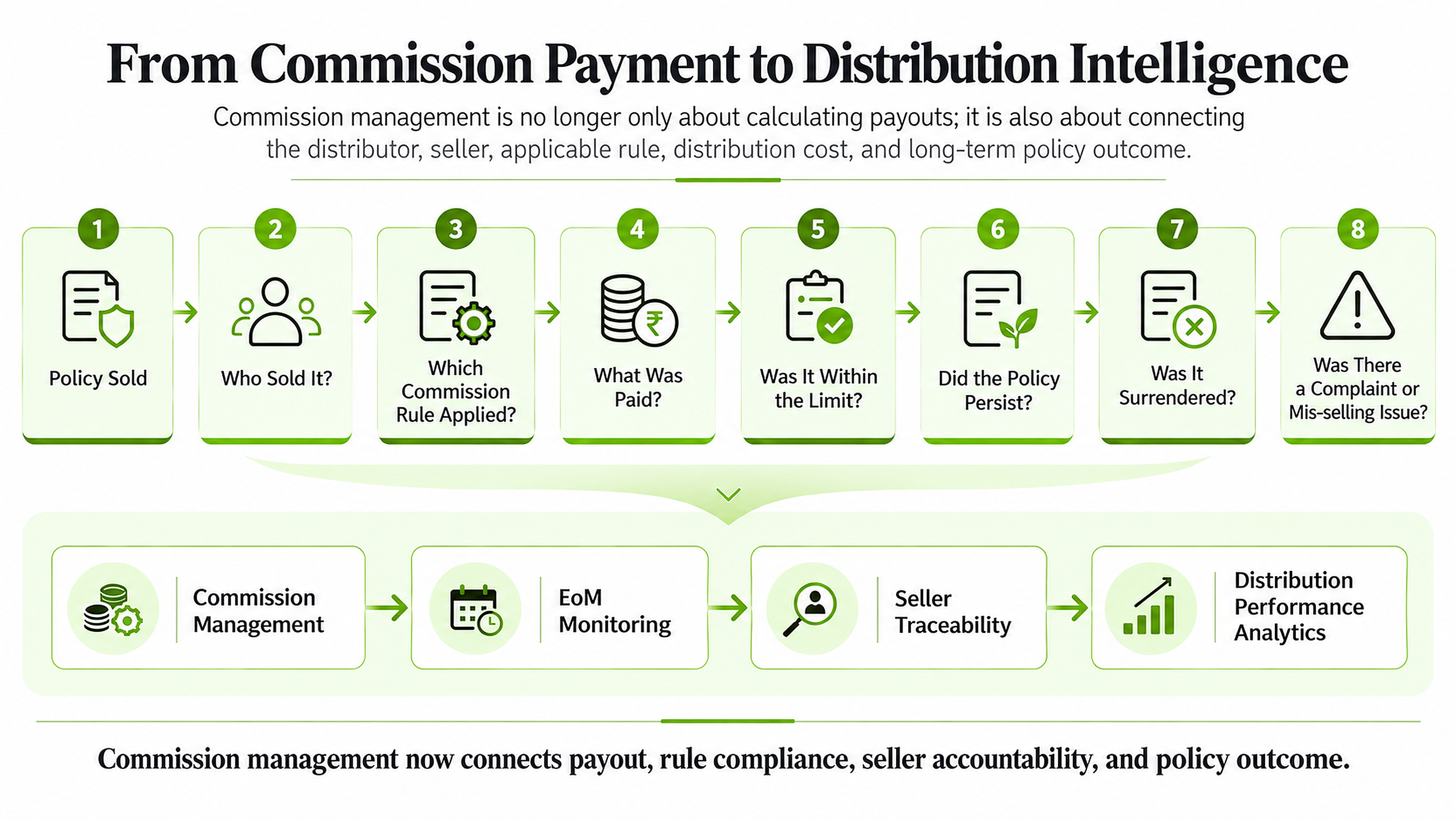
Commission data may sit in one system, policy information in another, complaints elsewhere, and persistency or surrender data in separate reporting environments.
Solving this type of insurance data exchange problem becomes important when distributor, policy, commission and servicing information must be viewed together.
If distribution performance is increasingly assessed using both cost and customer outcome, bringing these data points together becomes much more important.
Where Can Technology Help Insurers Adapt?
Technology cannot determine the final regulatory framework, but it can make the operational response easier once rules and internal policies need to be implemented.
Four areas become particularly relevant.
1. Commission Rule, Calculation and Compliance Management
Commission structures can vary by:
- product
- distribution channel
- distributor type
- policy tenure
- renewal year
A configurable insurance commission management system can map those rules against individual transactions.
For example, when a policy is issued, the workflow can:
- identify the product and distribution channel
- determine the applicable commission rule
- calculate the expected payout
- validate it against the applicable limit
- flag exceptions requiring review
- maintain an audit trail of the calculation
Automating these checks can also help insurers reduce agent commission errors caused by fragmented rate tables, policy data and reconciliation processes.
The objective is not simply faster calculation.
It is being able to answer:
Which rule was applied to this payout, and why?
That becomes valuable when insurers are managing multiple products, distributors and changing regulatory requirements.
EoM Monitoring and Cost Control
Commission is only one component of overall distribution cost.
An EoM monitoring layer can bring together commission, acquisition and other relevant distribution expenses so insurers can see how costs are developing across:
- products
- lines of business
- distribution channels
- distributors
- regions
- reporting periods
Internal thresholds can then be monitored before the end of a reporting cycle.
Instead of asking only whether an individual commission transaction is correct, finance and distribution teams can see whether overall distribution economics are moving toward internal or regulatory limits.
This becomes even more useful when connected with insurance regulatory reporting automation, where data from multiple systems needs to be validated and prepared for regulatory reporting.
Distributor and Seller Traceability
Greater seller accountability increases the importance of maintaining a clear link between the policy, distributor, individual seller and remuneration.
If a suitability concern or mis-selling complaint emerges later, insurers may need to identify:
- who sold the policy
- which distributor was responsible
- which commission arrangement applied
- how much was paid
- whether an exception was approved
- whether commission clawback needs to be reviewed
Connecting these records can create a clearer audit trail across the policy lifecycle.
Persistency and Distribution Performance Analytics
Commission data becomes more useful when it is connected with policy outcomes.
Consider two distributors generating the same amount of premium.
Their performance may look identical if the insurer measures only new business.
But one distributor may have:
- stronger persistency
- fewer complaints
- lower surrender levels
- fewer lapses
while another may produce the opposite outcome.
Connecting commission and distribution data with persistency, surrender, lapse and complaint information allows insurers to ask a better question:
What happened to the business after we paid to acquire it?
That moves distribution analysis beyond premium volume toward the quality and longevity of the business generated.
From Commission Management to Distribution Intelligence
The proposed IRDAI framework highlights why commission, distribution cost and customer outcomes may increasingly need to be viewed together.
A more connected distribution view could follow this path:
Who sold it → Which rule applied → What was paid → Was it within the limit → What did the business cost → Did the policy persist → Was it surrendered → Was there a complaint
The benefit is not limited to regulatory reporting.
It can also provide insurers with a clearer view of which products, channels and distribution relationships are creating sustainable business.
How InsurNest Can Help
InsurNest works with insurance businesses on digital and automation solutions across insurance operations.
For insurers assessing the operational impact of the proposed commission framework, capabilities such as commission rule management, EoM monitoring, seller traceability and distribution performance analytics can help connect information that otherwise sits across multiple workflows and systems.
If your team is reviewing how the proposed IRDAI commission changes could affect existing distribution, commission or reporting processes, talk to InsurNest about how these workflows can be simplified and automated.
What Should Insurers Watch Next?
The consultation paper should not yet be treated as the final IRDAI commission framework.
Insurers should closely watch the following areas.
Final Commission Limits
The percentages proposed in the consultation may change after industry feedback.
Implementation Timeline
Insurers and distributors will need clarity on when the revised framework becomes effective and whether transition periods will apply.
EoM Glide Path
Lower expense limits could influence operating models well beyond distributor commission.
Treatment of Indirect Remuneration
How incentives, rewards and non-monetary benefits are ultimately classified could materially affect existing distribution arrangements.
Mis-selling Accountability
Seller-level traceability and commission clawback could create stronger connections between distribution, complaints and policy data.
Bancassurance and NBFC Economics
Loan-linked insurance and lender-led distribution are among the areas that could experience significant structural change.
Persistency and Customer Outcomes
Insurers may increasingly need to evaluate distribution performance over the life of a policy rather than only when the policy is sold.
That could ultimately represent a more fundamental change than the commission percentages themselves.
What Is the Bigger Question Behind the Reform?
The debate is ultimately about more than commission percentages.
It asks a much more fundamental question:
What should an insurance distributor actually be rewarded for?
Is it:
- access to a customer?
- completing the transaction?
- providing advice?
- servicing the policy?
- helping create a policy relationship that remains suitable and sustainable over time?
In the sample examined by IRDAI, life insurance new business premium procured through corporate agents increased around 28%, while distributor remuneration increased approximately 125%.
That gap explains why distribution economics are receiving such close attention.
The final IRDAI commission rules may differ from the current consultation paper.
But the direction of the discussion is already significant.
Insurance distribution is increasingly moving from a conversation about premium volume and commission toward one about cost, accountability, suitability and long-term customer value.
Sources
Frequently Asked Questions
What are the IRDAI commission rules 2026?
IRDAI's 2026 consultation proposes product- and channel-specific commission limits, lower Expenses of Management limits, broader remuneration disclosures, stronger seller accountability, commission clawback for mis-selling, and changes to loan-linked insurance distribution.
Are the IRDAI commission rules 2026 final?
No. The commission limits and distribution changes discussed in the 2026 consultation paper are proposals and should not be treated as final regulations until IRDAI issues the final framework.
What is the proposed IRDAI commission cap for individual health insurance?
The consultation proposes a maximum commission of 15% for distribution entities and 20% for agents on the first sale of individual health insurance. For renewal or porting, the proposed limits are 5% and 10% respectively.
What is the proposed commission for loan-linked single-premium term insurance?
For single-premium term insurance distributed by lenders along with a loan, IRDAI proposes a maximum commission of 2% for distribution entities.
How could the IRDAI commission reforms affect insurers?
Insurers may need to review commission structures, distribution costs, Expenses of Management, bancassurance arrangements, seller-level traceability, mis-selling controls, and how distributor performance is measured over the policy lifecycle.
What changes are proposed for Expenses of Management?
IRDAI proposes reducing the company-level EoM limit for life insurers to 15% of gross direct premium income within two years and 12.5% within five years. For general insurers, the limit would move from 30% of gross written premium to 20% of domestic gross direct premium income over five years.
How could the proposed rules affect bancassurance and NBFC distribution?
The proposals could affect bancassurance and NBFC economics through lower commission limits, restrictions on volume-linked incentives, greater transparency around remuneration, and changes to the way loan-linked insurance is offered to customers.
Why is persistency relevant to the IRDAI commission reforms?
IRDAI's analysis connects distribution remuneration with longer-term policy outcomes such as persistency, surrender, lapse, and complaints. This could encourage insurers to evaluate distributors not only by premium generated but also by the quality and longevity of the business.
How can technology help insurers manage the proposed commission changes?
Technology can help insurers configure commission rules, validate payouts against applicable limits, monitor Expenses of Management, trace policies to distributors and individual sellers, maintain audit trails, and connect commission data with persistency, surrender, and complaint outcomes.

Hitul Mistry
CEO, Insurnest
An InsurTech leader with more than a decade of experience across insurance and technology, focused on solving business problems with the help of technology. Has worked with brokers, insurance carriers, and reinsurance firms across the India, UAE, and US markets.
View LinkedIn profile →
